What Is the Downside of Red Light Therapy?
What is the downside of red light therapy? For most healthy adults who use a well made device exactly as directed, the downside is small: mild and temporary skin redness, eye strain if you skip eye protection, and a real chance of paying a lot of money for a modest or uncertain benefit. The bigger downsides show up at the edges: misuse that burns skin or strains eyes, photosensitive conditions and medicines that make light exposure risky, a dose curve where more light can work less well, and a market full of devices whose output claims have never been independently checked.
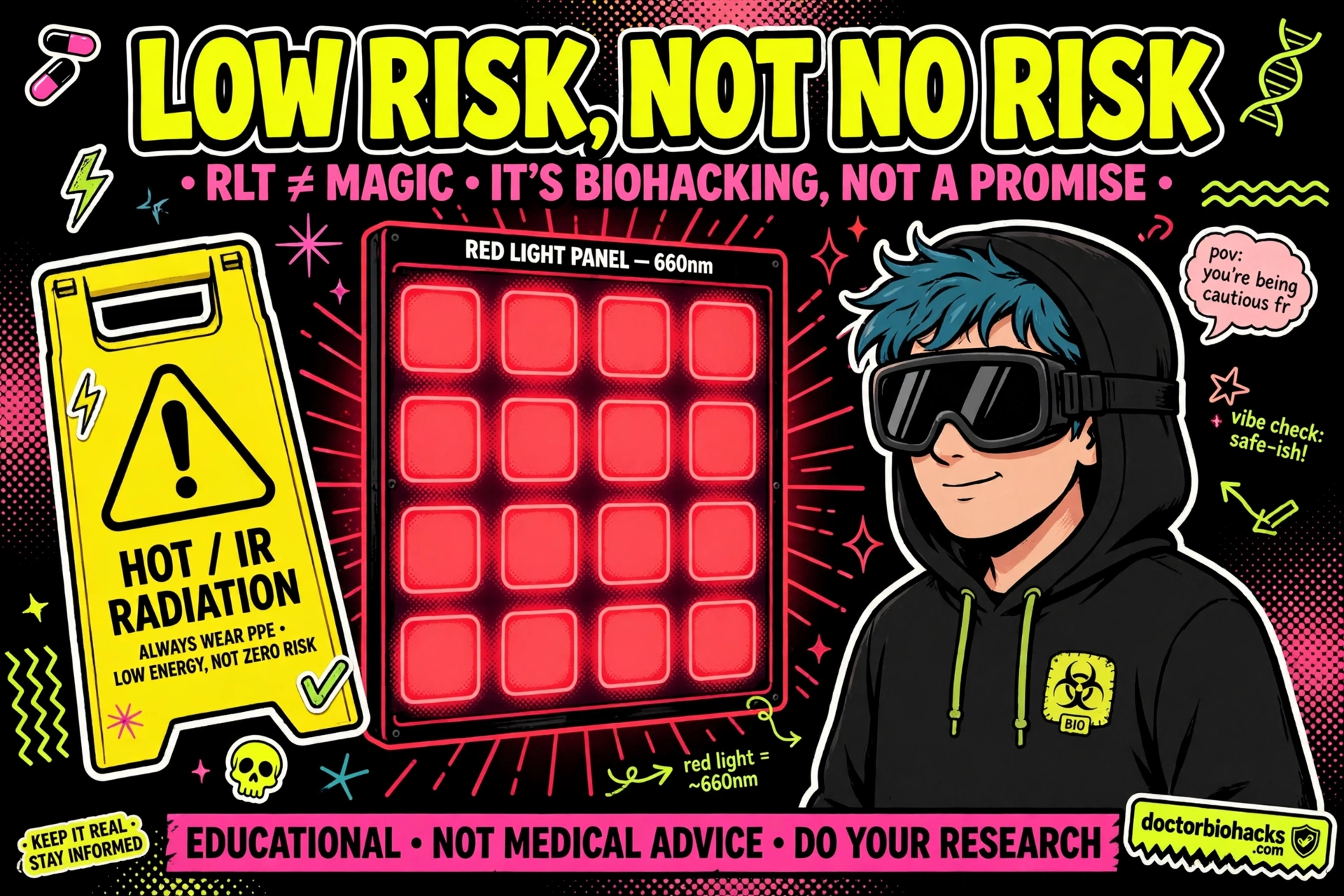
The quotable version: red light therapy is low risk, not no risk, and low evidence for most of the claims on the box. It uses red and near-infrared light, not ultraviolet light, so it does not carry the DNA damage risk of sunbeds, and no evidence links it to cancer. But Cleveland Clinic puts the position plainly: used short term and as directed it appears safe, misuse can damage skin or eyes, and the long term safety of home devices is not yet known. That sentence, more than any marketing claim, should set your expectations before you buy a panel, a mask or a cap.
What red light therapy actually is
Red light therapy, also called photobiomodulation, shines specific wavelengths of red and near-infrared light onto skin and the tissue beneath it. The proposed mechanism is photochemical rather than thermal: light is absorbed by mitochondria, the energy producing structures in cells, and that absorption is thought to support ATP production and cell signalling. It is not a sunbed, it does not tan you, and it does not use ultraviolet radiation. Home devices usually take the form of panels, face masks, handheld wands or caps, while clinics can use stronger equipment under supervision.
The evidence is uneven by condition, and that unevenness is itself a downside for a buyer. There is reasonable trial support for some skin and wound uses, and a growing literature on pain and recovery, but many popular claims, from whole body rejuvenation to brain optimisation, rest on small trials, short follow ups or animal and cell studies. A device cleared by a regulator for one specific use, such as skin appearance, is not proof that the same device works for every benefit listed on its sales page. In the United States, Food and Drug Administration clearance means a device is considered substantially equivalent to a device already on the market for that use. It is not the same as proof that it works for every claim a seller makes.
Downside of red light therapy: your eyes are the most likely casualty
Eye risk is the downside most often downplayed in marketing and most easily avoided in practice. Bright red and near-infrared panels can cause glare, eye strain and temporary afterimages, and staring directly into LEDs is never a good idea. A systematic review of light therapy and the eyes, published in 2017, found it safe for healthy, unmedicated adults, and a 2025 dermatology consensus described photobiomodulation as a safe treatment modality for adult patients. Those reassuring findings come with conditions: healthy adults, appropriate doses, and devices used as directed.
The sharper warning concerns focused beams rather than panels. Two low level red laser devices sold for children’s myopia approached or exceeded retinal exposure limits after three minutes of direct viewing, according to a 2024 analysis by Ostrin. Those devices shine a focused beam directly into the pupil, which is very different from standing in front of a panel, but the lesson carries over: never stare into the light source, always use the eye protection supplied with your device, and never swap in ordinary sunglasses as a substitute. A clinical exception proves the rule about supervision. In the LIGHTSITE III trial, a clinic device delivering 590, 660 and 850 nanometre light directly to the eyes of people with dry age related macular degeneration showed a favourable safety profile over 24 months, and the same device received United States authorisation for certain dry macular degeneration patients in November 2024. That was a medical device, in a clinic, for a diagnosed condition, under trial protocol. It is not a reason to aim a consumer panel at your own eyes.
If you notice lasting eye discomfort, blurred vision or spots after a session, stop and see an eye doctor rather than pushing through. People with an existing eye condition should ask an ophthalmologist before starting, and anyone using a face mask should follow the maker’s eye protection directions and keep their eyes closed during the session.
Downside 2: skin burns, redness and pigment changes from misuse
At standard treatment intensities, the common skin effects are mild: temporary redness, warmth or tightness that fades within hours. In two randomised controlled trials led by Jared Jagdeo and published in 2020 in the Journal of Biophotonics, these effects stayed mild at standard intensities, with no serious adverse events reported. Blistering and prolonged redness turned up at very high, non typical doses. WebMD reports the same pattern: an early stage trial found that at high levels, red LED light can cause blistering and redness.
That dose dependence is the practical point. Burns and blistering are rare, and they are linked to misuse, heat or reduced sensation: sessions run too long, too close or too often, or a device used by someone who cannot feel heat well, such as a person with neuropathy. People with darker skin types may also be more likely to notice redness or pigment change, and heat from a device that feels hot is a warning sign, not a sign that it is working harder. If redness turns into blistering, peeling or irritation that does not settle, stop and see a dermatologist. Isolated reports also describe scar tissue becoming inflamed after therapy, resolving when treatment was modified, which is another reason to start short, watch the skin, and increase only gradually.
Downside 3: more light can work less well
Photobiomodulation follows a biphasic dose response, sometimes called the Arndt-Schulz curve. Too little light produces little effect. A middle range stimulates a biological response. Push the dose higher still and the response falls, and in experimental conditions it can be suppressed. Huang, Chen, Carroll and Hamblin set out this pattern for low level light therapy in Dose-Response in 2009, and Chung and colleagues summarised the same logic for the wider field in Annals of Biomedical Engineering in 2012. In practical terms, fluences as low as 3 or 5 joules per square centimetre can be beneficial in living tissue, while a large dose such as 50 or 100 joules per square centimetre can lose the benefit and may even become detrimental, according to that review.
For a self-experimenter, this is the most counterintuitive downside of all. The instinct with a new device is to run it longer, sit closer and use it daily, on the theory that more input must mean more output. With red light, that instinct can quietly erase the benefit you are chasing, and it also explains why two studies of the same condition can disagree: they used different wavelengths, distances, durations and frequencies, and therefore delivered different total doses. There is no single universal protocol to copy, because dose depends on wavelength, power output, distance, area treated and duration together. Follow the specific device instructions for your condition and device, keep a simple log of distance, duration and frequency, and change one variable at a time. If you double everything at once and feel worse, you will not know which change caused it.
Downside 4: who should pause or check first
Some people should not start without medical advice, and a few should avoid it altogether for now. Cleveland Clinic dermatologist Jennifer Lucas advises that anyone with a photosensitive disorder, meaning sunlight causes blisters or burns, should avoid red light therapy, as should people taking medicines that increase sun sensitivity, including certain antibiotics and blood pressure medicines. Conditions in this group include lupus and porphyria, and the medicine list also covers some diuretics, anti-inflammatory drugs, antidepressants and vitamin A derivatives. Pulsing or strobing modes can be a trigger for photosensitive epilepsy, so anyone with a seizure disorder should discuss it with a neurologist first.
Pregnancy is a grey area rather than a proven danger. Limited research, including a study of 380 pregnant women who had used laser light treatments, found no safety signal, but that is a thin base for a general recommendation, and checking with an obstetrician or dermatologist first is the safer move. Active cancer needs the same caution in the other direction. There is no evidence that red light therapy causes cancer, and a 2023 systematic review found no clinical trial data linking light therapy for skin rejuvenation to new or recurrent cancer. The caution is practical, not theoretical: do not shine light directly on a known or suspected cancer without your oncology team agreeing, because stimulating cell activity around a tumour is not something to improvise.
Downside 5: the device market is the risk you cannot see
The largest downside for most buyers is not biological at all. It is that output claims vary widely between brands, and a cheap panel can deliver a different wavelength, a far lower irradiance or a less even field than its listing promises. Wavelength accuracy, measured irradiance at a stated distance and build quality differ a lot across at home options, and that variance shows up in both results and safety. A device that is underpowered wastes your time and money. A device that is far stronger than claimed, used at close range, raises the burn and eye strain risks described above.
Three checks cut through most of the noise. First, look for published wavelengths and measured irradiance at a stated distance, not just a wattage number for the whole panel. Second, look for clearance or registration with a recognised regulator for a specific use, and check what that use actually is. Third, look for photobiological safety testing against a recognised standard such as IEC 62471. None of these guarantees a benefit for your goal, but together they are the best available filter against a device that is either inert or unpredictable. If a seller cannot state wavelength, irradiance and distance, treat that as a missing safety specification, not a minor omission.
Downside 6: cost, time and delayed care
Red light therapy is not cheap, and it is not fast. Clinic sessions can cost 80 dollars or more each, home panels range from modest to several thousand pounds or dollars, and most protocols ask for several sessions a week for weeks before any change is plausible. Cleveland Clinic’s dermatology advice is blunt on this point: do not expect overnight results or dramatic changes to skin or hair. That slow, repeated commitment is also an opportunity cost. Every month spent faithfully standing in front of a panel for a problem that has a proven treatment, from inflammatory skin disease to a joint problem that needs assessment, is a month in which the proven treatment was delayed.
The same logic applies to sleep. Red light is not blue light, and it is not the melatonin suppressing screen glow that keeps people awake, but a bright light session late at night is still a stimulating routine close to bedtime, and some users report headaches after extended high intensity use. Keeping sessions earlier in the day is a low cost precaution, and it avoids turning a recovery habit into a sleep problem. If a device makes your sleep worse, that is a real downside even if no trial has measured it in your exact situation.
A self-experimenter’s decision checklist
Work through this list before you buy, and again after two weeks of use. First, name the single outcome you are testing, such as skin redness or post training soreness, and how you will measure it, with a photo under the same light or a simple daily score. Second, check the pause list: photosensitive condition, photosensitising medicine, seizure disorder, pregnancy, active cancer or an eye condition. If any applies, get advice first. Third, verify the device: wavelengths, irradiance at a stated distance, regulator clearance for a stated use, and eye protection included. Fourth, start at the short end of the maker’s range, at the stated distance, with eyes protected, and log every session. Fifth, set a stop rule in advance: blistering, lasting eye discomfort, a flare of a skin condition or no change after a reasonable trial period all mean stop and reassess, not push harder.
That checklist is also the honest answer to the question this article started with. Red light therapy is not dangerous in the way a sunbed is dangerous, and it is not a scam in the way a miracle cure is a scam. Its downsides are quieter and more practical: eyes unprotected, skin overexposed, dose pushed past the useful range, the wrong person using it, the wrong device bought, and real money and months spent on a benefit that was never well supported for that goal. Respect those six downsides and the therapy stays in its proper place: a low risk tool with modest, condition specific evidence, worth trying carefully for the right reason, and worth dropping promptly when it is not delivering.
Frequently asked questions
Can red light therapy cause cancer? No evidence links it to cancer. It uses red and near-infrared light, not ultraviolet light, and a 2023 systematic review found no clinical trial data linking light therapy for skin rejuvenation to new or recurrent cancer. Do not use it directly on a known or suspected cancer without oncology advice.
Is red light therapy bad for your eyes? For healthy adults using devices as directed, the evidence is reassuring, but direct exposure can cause strain, glare and afterimages, and focused laser devices aimed at the eyes carry a higher risk. Wear the supplied eye protection, never stare into the LEDs, and see an eye doctor if discomfort lasts.
Can you overdo red light therapy? Yes, and overdoing is a downside of red light therapy, it can reduce the benefit as well as raise the risk of redness or burns. Photobiomodulation follows a biphasic dose response: too little does little, a middle range stimulates a response, and too much can suppress it. Follow the device instructions for distance, duration and frequency.
Who should not use red light therapy? People with photosensitive conditions such as lupus, people taking photosensitising medicines, and people with photosensitive epilepsy should check with a clinician first. Pregnant users, people with an eye condition and people with active cancer should also get advice before starting.
Does FDA clearance mean a device works? No. Clearance means the device is considered substantially equivalent to a device already on the market for a stated use. It is a safety and equivalence signal for that use, not proof of every benefit a seller claims.
How long before red light therapy works? Do not expect overnight or dramatic results. Most protocols need several sessions a week for weeks, and the right response to no change after a reasonable trial is to stop and reassess, not to increase the dose.
Sources
- Cleveland Clinic Newsroom, Can Red Light Therapy Improve Your Skin and Hair? (2 September 2026), with dermatologist Jennifer Lucas on photosensitivity, medicines and realistic expectations.
- Cleveland Clinic, Red Light Therapy (2024): short term use as directed appears safe; misuse can damage skin or eyes; long term safety of home devices not yet known.
- WebMD, Red Light Therapy: high level LED light can cause blistering and redness; eye protection recommended; no evidence it causes cancer.
- Huang, Chen, Carroll and Hamblin, Biphasic Dose Response in Low Level Light Therapy, Dose-Response (2009), via PubMed Central PMC2790317.
- Chung and colleagues, summarising the biphasic photobiomodulation dose response, Annals of Biomedical Engineering (2012).
- Jagdeo and colleagues, randomised controlled trials of red light therapy for skin, Journal of Biophotonics (2020): mild effects at standard intensities, no serious adverse events.
- Glass (2023) systematic review: no clinical trial data linking light therapy for skin rejuvenation to new or recurrent cancer.
- Ostrin (2024): two low level red laser devices for children’s myopia approached or exceeded retinal exposure limits after three minutes of direct viewing.
- Jaffe and colleagues, LIGHTSITE III, Retina (2026): 590, 660 and 850 nanometre clinic device for dry age related macular degeneration, favourable safety profile over 24 months; United States authorisation for certain patients in November 2024.
- Maghfour and colleagues, dermatology consensus (2025): photobiomodulation described as a safe treatment modality for adult patients.
Read next on Doctor Biohacks: Sauna or Cold Plunge: Which Is Better for Recovery and Longevity?, How Often Should You Cold Plunge? The Protocol That Makes Sense and Does Intermittent Fasting Cause Muscle Loss? What a 12-Month Trial Found. External source: https://pmc.ncbi.nlm.nih.gov/articles/PMC2790317/