Can Sleep Slow Biological Ageing? A Proteomic Protocol Read
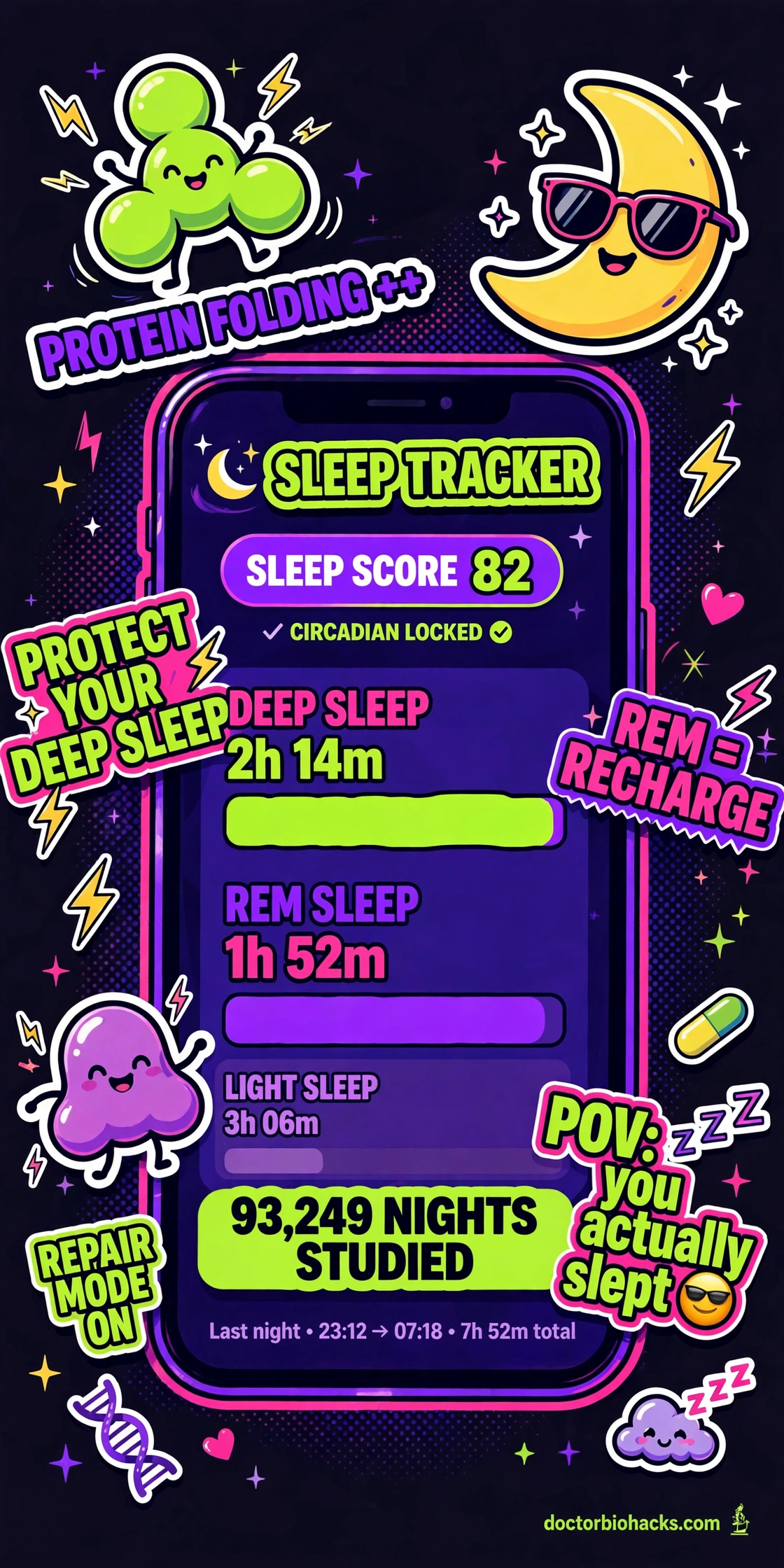
Here is the short answer. In a 2026 Aging Cell study of 93,249 UK Biobank adults, longer total sleep duration, more deep sleep and more REM sleep were each associated with lower risk of most of nine hallmarks of ageing, while more time awake after falling asleep and more irregular sleep schedules were associated with higher risk. The sleep data came from wrist-worn accelerometers, not questionnaires, and plasma proteomics pointed to immune and inflammatory pathways as the shared biology. This article decodes the study for self-experimenters and turns the six sleep patterns it measured into a protocol you can run on yourself, with honest limits on what the evidence can claim.
The study, decoded
The research is titled “Associations Between Accelerometer-Assessed Sleep Patterns, Proteomic Signatures, and Hallmarks of Aging in Adulthood.” It was led by Liu and colleagues and published in Aging Cell in 2026 (DOI 10.1111/acel.70685). The team drew on the UK Biobank, starting with roughly 103,000 adults who agreed to wear an Axivity AX3 accelerometer on their dominant wrist for seven days. After quality control and excluding people already diagnosed with age-related disease, the main analysis covered 93,249 participants.
Three things make this study stronger than the average sleep paper. First, sleep was measured objectively. A deep learning model called SleepNet converted the raw accelerometer signal into six defined sleep patterns, and SleepNet was validated against polysomnography, the clinical gold standard, in independent cohorts. Second, ageing was measured as outcomes, not vibes. The team mapped 83 age-related diseases from hospital and GP records onto nine established hallmarks of ageing: genomic instability, telomere attrition, epigenetic alterations, loss of proteostasis, deregulated nutrient sensing, mitochondrial dysfunction, cellular senescence, stem cell exhaustion and altered intercellular communication. Third, the models were heavily adjusted for age, sex, ethnicity, education, deprivation, income, BMI, living arrangements, physical activity, smoking and alcohol, with false discovery rate correction across every comparison.
The proteomics layer ran on 9,275 participants with plasma protein data from the UK Biobank Pharma Proteomics Project: 2,920 proteins measured with the Olink Explore platform. The goal was to find proteins associated with both a sleep pattern and an ageing hallmark, the shared molecular signatures of the two.
Six sleep patterns, and what each one showed
The six accelerometer-derived patterns were total sleep duration, REM sleep duration, deep sleep duration (NREM stage N3), light sleep duration (NREM stages N1 and N2), wakefulness after sleep onset (WASO) and sleep irregularity, defined as the seven-day standard deviation of sleep duration.
The results split cleanly into three groups:
- More is better. Longer total sleep duration, greater deep sleep and increased REM sleep were associated with lower risk of most ageing hallmarks. Deep and REM sleep, the two architecture stages, carried the signal; duration alone was not the whole story.
- Worse is worse. Higher WASO, the minutes spent awake after first falling asleep, and greater sleep irregularity were associated with higher risk. An erratic schedule was its own risk factor, independent of total hours.
- Light sleep did nothing. Light sleep duration showed no significant associations with any hallmark. For self-experimenters, that is a useful null result: the metric to chase is not total hours but how the hours are composed.
This reframes the self-experiment. Two people can both log seven hours while having very different deep sleep, REM, WASO and regularity profiles, and this study says those differences map onto ageing biology, not just next-day grogginess.
The protein layer: immune and inflammatory pathways
The overlapping proteins, those significantly associated with both a sleep pattern and an ageing hallmark, numbered between 1 and 558 depending on the specific pair. Gene Ontology enrichment showed they were predominantly involved in immune and inflammatory pathways. Several proteins appeared repeatedly across multiple sleep patterns and hallmarks: IL1RN, FABP1, GDF15 and LEP.
That pattern is biologically legible. Short and fragmented sleep has long been linked to systemic inflammation, and inflammatory proteins like these sit on pathways that connect immune activation to cardiovascular disease, metabolic dysfunction and neurodegeneration. The study does not prove that bad sleep raises these proteins or that the proteins drive ageing; it establishes them as shared signatures worth testing in causal designs. For protocol purposes, the takeaway is directional: sleep architecture and systemic inflammation are measuring the same underlying process from two angles.
How this differs from the sleep-duration sleep chart
Regular readers may remember our earlier post on the MULTI Consortium sleep chart, which mapped self-reported sleep duration against 23 organ ageing clocks and found the lowest biological age gaps between 6.4 and 7.8 hours. That study answered “how long” with a U-shaped curve. This one answers “what kind.” The differences matter for your protocol:
- Measured, not remembered. Accelerometer sleep replaces questionnaire sleep, removing the optimism bias that makes people over-report their hours.
- Architecture, not just duration. Deep sleep and REM get their own coefficients instead of being folded into one total.
- Quality has a price tag. WASO and irregularity are risk factors in their own right, not just footnotes to short sleep.
- Outcomes are clinical. Hallmarks are operationalised through 83 real diseases rather than predicted biological age gaps.
Together they converge on one message: the 6.4 to 7.8 hour window is the quantity target, and inside that window, regularity plus deep and REM sleep plus minimal night-time wakefulness is the quality target.
Read the caveats before you rebuild your routine
An honest protocol read has to say what the study cannot prove. This is observational research with Cox models, so it identifies associations, not causal effects. People with early undiagnosed illness sleep differently, which can make poor sleep look like the cause when it is partly the marker.
SleepNet staging has real error. In external validation against polysomnography, the three-class model (wake, REM, NREM) scored an F1 of 0.49, and estimated total sleep duration differed from polysomnography by about 48 minutes. Wrist accelerometry is far better than questionnaires but far from a sleep lab, so treat your own wearable’s deep sleep and REM numbers as estimates with wide bands, not lab values.
The proteomics were correlational too: proteins jointly associated with sleep and hallmarks are hypotheses about shared biology, not proof of mechanism. The proteomic subset was 9,275 people, not the full 93,249. And the UK Biobank cohort skews healthier and more affluent than the general population, so effect sizes may not map perfectly onto other groups.
The sleep architecture protocol
The six patterns translate into five levers. Run them as a four-week self-experiment: week zero is baseline measurement only, weeks one to four add the levers in order, and track the metrics each lever is meant to move.
Lever 1: Fix regularity first
Why: sleep irregularity was independently associated with higher hallmark risk. A consistent schedule may matter as much as a long one.
Do: anchor a fixed wake time, even on weekends, within a 30-minute window. Let bedtime drift around it rather than the other way round; wake time is the lever the circadian system actually locks onto. Track: the seven-day standard deviation of your sleep duration, the exact metric the study used. Watch it fall.
Lever 2: Protect deep sleep
Why: greater deep sleep duration was associated with lower hallmark risk, and deep sleep is the stage most sensitive to lifestyle inputs.
Do: get daytime exercise, ideally finishing at least three hours before bed; keep the bedroom cool and dark; avoid alcohol within three hours of bedtime, since alcohol suppresses slow-wave sleep even when it helps you fall asleep. Track: nightly deep sleep minutes from your wearable, read as a weekly average rather than a nightly verdict, given the staging error bands.
Lever 3: Protect REM
Why: increased REM sleep was associated with lower risk, and REM concentrates in the last third of the night, which is exactly what gets cut when you wake early.
Do: give yourself enough sleep opportunity. A fixed wake time plus a bedtime that allows a full night is how REM survives; alarms that truncate the last cycle steal REM disproportionately. Track: REM minutes as a weekly average, alongside total sleep duration.
Lever 4: Cut WASO
Why: minutes awake after sleep onset carried their own risk signal, separate from total duration.
Do: set a caffeine cutoff in the early afternoon; keep the room dark enough that night-time wake-ups stay brief; if you wake and cannot fall back asleep within about 20 minutes, get up rather than clock-watching, then return to bed when drowsy. Track: nightly WASO minutes. A downward weekly average is the win.
Lever 5: Anchor the system with morning light
Why: consistent wake time only works if the circadian clock believes you. Morning light is the strongest time cue.
Do: get bright outdoor light within an hour of waking. Our morning light therapy protocol covers the 30-minute, 10,000-lux approach for darker months, but even a cloudy-day walk counts. Track: wake time consistency, which should tighten as the light anchor does its work.
Frequently asked questions
Can sleep slow biological ageing?
No study has shown that changing your sleep changes your biological age. What the 2026 Aging Cell study showed is that objectively measured sleep patterns are associated with the risk of nine hallmarks of ageing: more deep and REM sleep with lower risk, more night-time wakefulness and more irregularity with higher risk. The honest claim is association with ageing biology, not proven reversal.
Does sleep quality matter more than sleep duration for ageing?
In this study they were independent. Total duration mattered, but so did deep sleep, REM, WASO and irregularity as separate patterns. Light sleep showed no associations at all. The practical reading is that duration sets the ceiling and architecture plus regularity determine how close you get to it.
Is an irregular sleep schedule as bad as short sleep?
The study treated irregularity, the seven-day standard deviation of sleep duration, as its own risk factor alongside short sleep, with higher irregularity associated with higher hallmark risk. The MULTI Consortium sleep chart paper also found that rest-activity consistency linked to epigenetic age. Fixing schedule regularity is one of the cheapest interventions available.
Can my wearable measure deep sleep and REM accurately?
Only approximately. The study’s own SleepNet model scored an F1 of 0.49 on three-class staging against polysomnography, and consumer wearables face the same fundamental limit: they infer stages from movement and heart rate, not brain waves. Our wearable accuracy guide covers which devices get closest to clinical measures. Track weekly averages of deep and REM minutes, not single nights.
Do the proteomic findings mean inflammation is the mechanism?
They suggest it is a shared signature, not a proven mechanism. The overlapping proteins between sleep patterns and ageing hallmarks were enriched in immune and inflammatory pathways, with IL1RN, FABP1, GDF15 and LEP appearing across multiple pairs. That is a strong hypothesis for causal testing, not a verdict.
How long before sleep changes show up in these biomarkers?
Unknown. The study measured sleep at one point and followed disease outcomes forward, so it says nothing about how quickly improving sleep might shift proteomic signatures. Treat any protocol as a months-long experiment with sleep metrics as the feedback signal, not protein panels.
Related reading: the 6.4 to 7.8 hour sleep-longevity window for the quantity target, our morning light therapy protocol for the circadian anchor, and how sleep debt compounds in the sleep debt science post.
Sources
- Liu et al., “Associations Between Accelerometer-Assessed Sleep Patterns, Proteomic Signatures, and Hallmarks of Aging in Adulthood,” Aging Cell, 2026, DOI 10.1111/acel.70685: full text (abstract and methods verified against the published article)
- O’Toole, C. K., et al., “Sleep chart of biological ageing clocks in middle and late life,” Nature, 2026, DOI 10.1038/s41586-026-10524-5: paper
- Tawadros and Arkan, “Sleep duration links to biological aging clocks,” Signal Transduction and Targeted Therapy, 2026, DOI 10.1038/s41392-026-02997-7: highlight