Which Wearable Is Most Accurate for HRV? What 536 Nights Against ECG Actually Found
If you only care about overnight HRV accuracy, the best validated answer right now is a finger-based ring. In the largest same-night, at-home comparison we have, Oura Ring Gen 4 tracked closest to an ECG reference over 536 nights, with a concordance correlation coefficient of 0.99 and a mean absolute percentage error of 5.96 percent. Oura Gen 3 was next at 0.97, then WHOOP 4.0 at 0.94. Garmin Fenix 6 and Polar Grit X Pro were further behind in that specific test.
That ranking matters because Apple has just added a daily Readiness score to the new Apple Watch Series 12 and Ultra 4. A readiness score is only as trustworthy as the sensor and the sleep window underneath it. Before you let a 0 to 10 score decide your training day, it is worth asking a simpler question: which wearable is most accurate for HRV in the first place?
Why HRV is harder to measure than heart rate
Heart rate variability, or HRV, is the variation in time between successive heartbeats. It is usually reported as RMSSD, the root mean square of successive differences, measured in milliseconds. Higher overnight RMSSD generally reflects greater parasympathetic, or rest and digest, influence. Lower than your usual values can follow hard training, poor sleep, alcohol, illness, travel or psychological stress.
That sounds simple. Measuring it with a consumer wearable is not.
Almost every ring, strap and watch you can buy estimates HRV from photoplethysmography, or PPG. A green light shines into the skin and the device infers each pulse from changes in blood volume. That is pulse rate variability, not a direct electrical recording of the heart. An ECG measures the electrical signal itself. A chest strap such as the Polar H10 samples that signal at 1,000 Hz and is used as the reference standard in validation work.
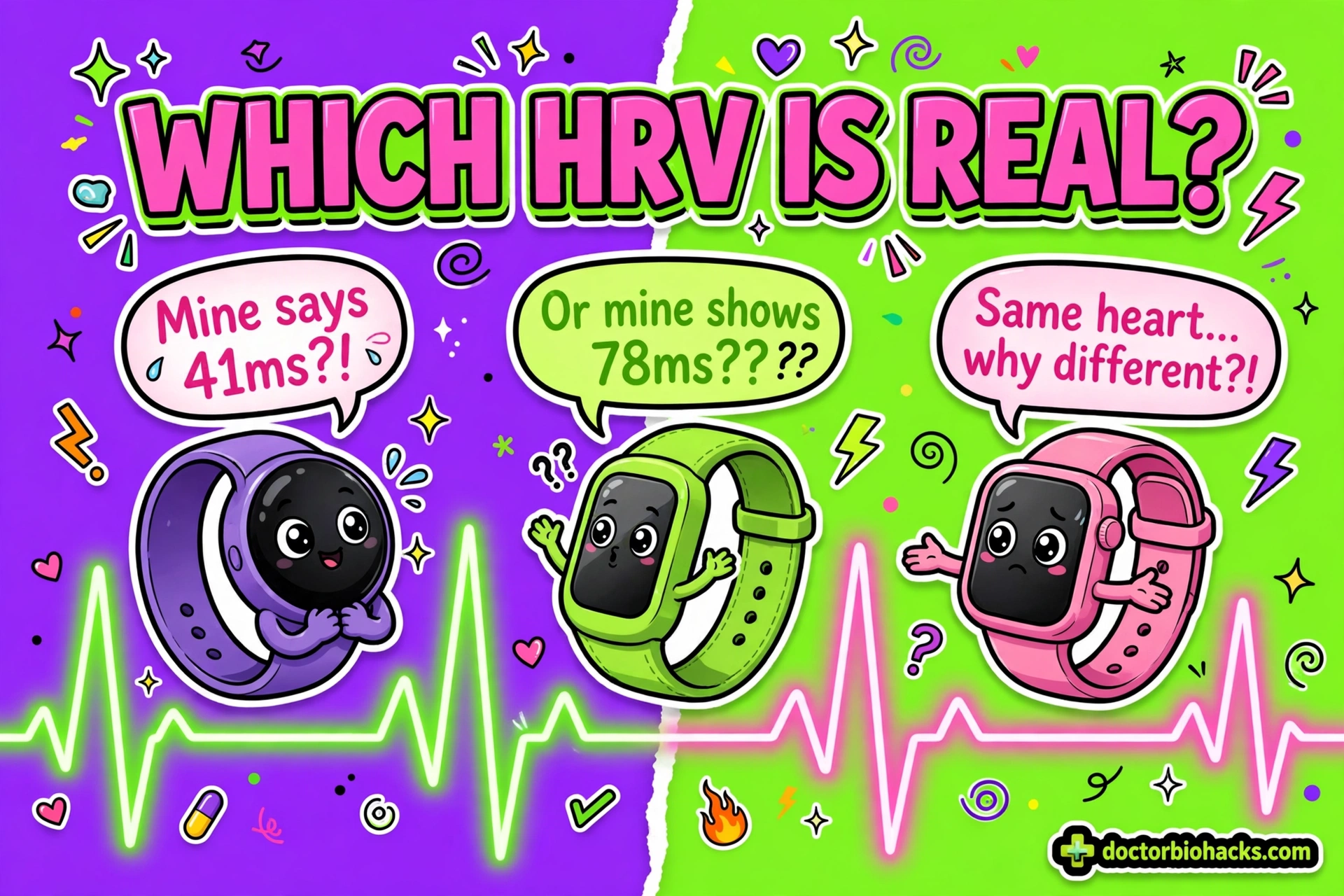
PPG can work very well when you are still and asleep. It gets messy when you move, when the fit is loose, when skin contact changes, or when the device tries to clean up a noisy signal with a proprietary algorithm. Each brand samples at different rates, chooses different windows across the night, filters artefacts differently and weights the night differently. None of that is fully published. So two devices on the same body on the same night can legitimately report different HRV numbers, and both can claim to be measuring HRV.
There is a second units trap. Apple Health has historically stored SDNN, a different HRV statistic, while most training platforms report RMSSD. They come from the same heartbeats but they are not interchangeable. Comparing an SDNN number from one app with an RMSSD number from another is comparing two different summaries. Always compare a device against its own baseline, in its own units.
What did the 536-night validation study actually test?
The study that anchors this article was published in Physiological Reports in 2025 by Dial and colleagues, working with Ohio State University and the Air Force Research Laboratory. Thirteen healthy adults wore multiple devices at home for 536 nights in total. This was not a single laboratory night with perfect conditions. It was real sleep, at home, night after night.
Alongside the wearables, each participant wore a Polar H10 chest strap as the ECG reference. The devices tested were Oura Ring Gen 3, Oura Ring Gen 4, WHOOP 4.0, Garmin Fenix 6 and Polar Grit X Pro. The researchers compared each device’s sleep-based HRV and resting heart rate against the ECG reference across all nights.
That design is exactly what self-experimenters should want. Same people, same nights, same reference, different devices. It does not prove what happens during a hard interval session, and thirteen healthy adults is a small sample. It does give the cleanest same-night ordering we currently have for overnight HRV.
The headline numbers
For overnight HRV, agreement with ECG was reported as a concordance correlation coefficient, where 1.00 is perfect agreement:
- Oura Ring Gen 4: CCC 0.99, mean absolute percentage error 5.96 percent.
- Oura Ring Gen 3: CCC 0.97, mean absolute percentage error 7.15 percent.
- WHOOP 4.0: CCC 0.94, mean absolute percentage error 8.17 percent.
- Garmin Fenix 6: CCC 0.87, mean absolute percentage error 10.52 percent.
- Polar Grit X Pro: CCC 0.82, mean absolute percentage error 16.32 percent.
Resting heart rate was easier for every device. All of them were close to ECG overnight, with Oura again showing the least bias. That pattern is consistent with the wider literature: resting heart rate is a robust signal, HRV is a fragile one.
Two practical points follow. First, the finger beat the wrist in this test. A ring sits on a finger with a strong pulse signal and the hand tends to move less than the wrist during sleep. Second, a single night from a device with a wide error spread should not drive a decision. The Polar Grit X Pro result, for example, came with a much wider night-to-night variation than the Oura result, which is another way of saying its individual nights were less predictable in this sample.
Expert commentary around the study made the same threshold point. Performance scientist Mark Kovacs has argued that a wearable within about 5 percent of ECG for resting heart rate and within about 10 milliseconds for HRV is good enough to guide most training decisions, because the goal is consistent trend data night after night, not a clinical replacement for ECG. On that standard, the top three devices in this study are all usable for trends. They are not equally tight on absolute values.
So why do wearables disagree with each other?
If you have ever worn two devices on the same night and woken up with two different HRV scores, you have seen this in person. The validation data suggest at least five reasons.
First, measurement site. Finger, wrist and upper arm do not give identical PPG signals. Placement studies with identical WHOOP units worn at different arm positions have shown that placement alone changes accuracy, with more proximal placements often doing better at rest and during steady exercise.
Second, the sleep window. One brand may average the whole night, another may weight the first hours more heavily, and another may take a snapshot window. HRV is not flat across the night. It changes with sleep stage, breathing and awakenings. Different windows produce different summaries of the same night.
Third, artefact handling. Turning over, a loose strap or a watch that shifts on the wrist creates gaps. Each algorithm decides differently what to keep, what to interpolate and what to discard.
Fourth, the statistic. RMSSD, SDNN and log-transformed versions behave differently. A change that looks dramatic in one can look modest in another.
Fifth, the composite score on top. Readiness, recovery and strain scores combine HRV with resting heart rate, sleep duration, sleep stages, temperature, respiratory rate and recent training load, each weighted by a private formula. Even if the HRV input were perfect, the final score is a separate, largely unvalidated layer.
This is why the sensible rule has not changed: pick one device, wear it the same way every night, and follow its trend. Do not compare your absolute HRV with a friend’s, and do not switch devices and expect the baseline to carry across.
What about Apple’s new Readiness score?
In September 2026 Apple introduced a daily Readiness score on Apple Watch Series 12 and Ultra 4. It condenses recent activity, overnight and daytime vitals and sleep into a 0 to 10 number with four labels: Recover, Pace Yourself, Ready and Go For It. The score can move during the day as new activity and vitals arrive.
Underneath it, Apple says the new Health Sensing System records heart rate every five seconds and samples HRV up to 24 times more often than before, including a new Recovery HRV measure set against a personal baseline. The score needs seven nights of consistent sleep tracking to establish that baseline, and it draws on Training Load, overnight vitals such as respiratory rate and wrist temperature, and Apple’s Sleep Score.
None of that is unreasonable. More frequent sampling should help, and asking for seven nights before judging you is more honest than scoring you on night one. But two cautions follow directly from the validation literature.
One, Apple Watch was not in the Dial 2025 same-night test, so there is no 0.99-style figure to place it on that table. Earlier controlled work on Apple Watch HRV has produced results that vary by metric and protocol. A newer sensor does not automatically inherit an older model’s validation, and it does not create a new one.
Two, a validated sensor input does not validate a composite score. Reviewers of readiness scores across brands have made the same point repeatedly: manufacturers have published far more evidence that their devices can measure heart rate and HRV at rest than that following the final readiness number improves performance, prevents injury or speeds recovery. That gap applies to Apple, Garmin, Oura and WHOOP alike. Treat any readiness score as a prompt to look at the underlying signals, not as an instruction.
Which wearable is most accurate for HRV, by use case?
The question in the title has a narrow answer and a useful answer. The narrow answer is Oura Ring Gen 4 for overnight HRV and resting heart rate, on current same-night evidence. The useful answer depends on what you actually do.
If recovery tracking is your main job for the device, a ring worn every night is hard to beat. It is comfortable, it stays in place, and in Dial 2025 it matched ECG most closely. You pay for that with a subscription and with a device that tells you little about the workout itself.
If you already train with a WHOOP strap, the news is good enough. At CCC 0.94 in the same study, WHOOP 4.0 was clearly behind Oura but comfortably usable for trends, especially when you read HRV alongside resting heart rate and sleep. Absolute values will differ from a ring. Your own rolling baseline is what matters.
If you are a runner or multisport athlete who lives in Garmin or Apple Watch for training, keep the watch for training and be more conservative with its HRV. Multisport watches lead on workout, GPS and performance estimates in other validation work, but their overnight HRV agreement was weaker in Dial 2025 for the Garmin model tested, and Apple Watch HRV has its own metric and sampling quirks. Use their HRV directionally, lean harder on resting heart rate, sleep and how you actually feel, and consider a chest strap for sessions where heart rate accuracy really counts.
If you want the most accurate HRV reading at home and do not mind a strap, the reference devices in these studies are chest straps. That is not a fashionable answer, but it is the honest one. A validated chest strap paired with a morning HRV app remains the closest home option to ECG.
How to use your HRV number without being used by it
Buy accuracy if you like, but method matters more than brand. These rules come straight from how the validation studies were run and how practitioners who use HRV with athletes actually work.
Wear the same device, the same way, every night. Consistency of fit and position matters more than chasing the top-ranked device and wearing it loosely.
Read trends over three to seven days. One low night after a late meal, alcohol or a hard evening session is information, not a verdict. Kovacs and others who work with professional athletes use rolling three-day and seven-day averages for exactly this reason.
Read HRV with resting heart rate. HRV down plus resting heart rate up, sustained over two or three days with poor sleep, is a much clearer taxed signal than HRV alone. HRV down with normal resting heart rate and normal energy is usually a train-with-slightly-less-intensity day, not a day off.
Keep conditions steady when you can. Caffeine late in the day, alcohol, late heavy meals, travel across time zones and a very late bedtime all move overnight HRV. If you change five things at once, the number cannot tell you which one mattered.
Keep a tiny log. Sleep quality, HRV change, resting heart rate change, mood and what you trained, in one line a day. Two weeks of that teaches you more about your own physiology than any generic threshold.
Do not chase a universal number. There is no correct HRV for your age that a wearable can hand you. There is only your baseline, your usual range, and sustained departures from it.
What the evidence does not support
It does not support calling any consumer wearable’s HRV clinically interchangeable with ECG for every person. It does not support making a hard training decision from a single night’s value. It does not support assuming a new model inherits an old model’s accuracy, or that a readiness score built on HRV has itself been validated against outcomes. And it does not support daytime or during-exercise HRV from an optical wrist sensor as a strong signal. Movement is the enemy of PPG, and validation results consistently worsen as intensity rises.
That is not an argument against wearables. Overnight, at rest, worn consistently, the best of them now track ECG closely enough to be genuinely useful. It is an argument for using them at the strength the evidence actually supports: trend tools for self-experimentation, not oracles.
The bottom line
Which wearable is most accurate for HRV? On the best same-night evidence available, Oura Ring Gen 4, followed by Oura Gen 3 and then WHOOP 4.0, with the Garmin and Polar watches tested further behind. Apple’s new Readiness score on Series 12 and Ultra 4 is an interesting new layer, but until its HRV and its composite score are put through the same kind of independent, same-night validation, it should be read as Apple has framed the inputs, not as a settled ranking.
Choose the device you will actually wear every night. Build seven to fourteen nights of baseline before you judge anything. Then let sustained trends, not single mornings, steer the small decisions: a set fewer, an easier day, an earlier night. That is how a wearable becomes a biohacking tool instead of a source of morning anxiety.
Frequently asked questions
Which wearable is most accurate for HRV?
In the Dial et al. 2025 study of 536 nights against a Polar H10 ECG reference, Oura Ring Gen 4 was closest for overnight HRV with a concordance of 0.99 and about 6 percent mean error, followed by Oura Gen 3 at 0.97 and WHOOP 4.0 at 0.94.
Is WHOOP accurate for HRV?
Yes for trends. WHOOP 4.0 reached a concordance of 0.94 against ECG for overnight HRV in the same 536-night study, which practitioners generally regard as good enough to guide training when you follow your own rolling baseline rather than absolute values.
Does Apple Watch measure HRV accurately?
Apple Watch HRV has been tested in controlled protocols with results that vary by metric and study, and Apple Health has historically stored SDNN rather than the RMSSD most training platforms use. The Series 12 and Ultra 4 sample HRV far more often and add a Recovery HRV baseline, but they were not part of the Dial 2025 same-night ranking.
Why is my HRV different on two devices worn on the same night?
Because each device samples a different site, uses a different sleep window, filters artefacts differently and may report a different HRV statistic. They are estimating pulse rate variability from optical signals, not recording ECG directly, so disagreement between brands is expected.
Should I train based on my readiness score?
Use it as a prompt, not an instruction. The sensor inputs to readiness scores, especially overnight HRV and resting heart rate, are reasonably well validated at rest. The final composite score itself has little published evidence showing that following it improves outcomes, for any brand.
How many nights do I need for a useful HRV baseline?
Most platforms need about a week of consistent nights, and Apple asks for seven nights before its Readiness score starts. In practice, seven to fourteen nights of the same device worn the same way gives you a baseline worth acting on.
Sources
Dial et al., Physiological Reports (2025), wearable validation of nocturnal HRV and resting heart rate against Polar H10 ECG across 536 nights, as reported at mensjournal.com and summarised with CCC and MAPE values at aiclysm.com. Apple Watch Series 12 and Ultra 4 Readiness score, Health Sensing System sampling and seven-night baseline, as reported at webpronews.com. Wearable HRV accuracy evidence review and limits, sensai.fit.