The 6.4 to 7.8 Hour Sleep Window: Dialling In Your Longevity Sweet Spot
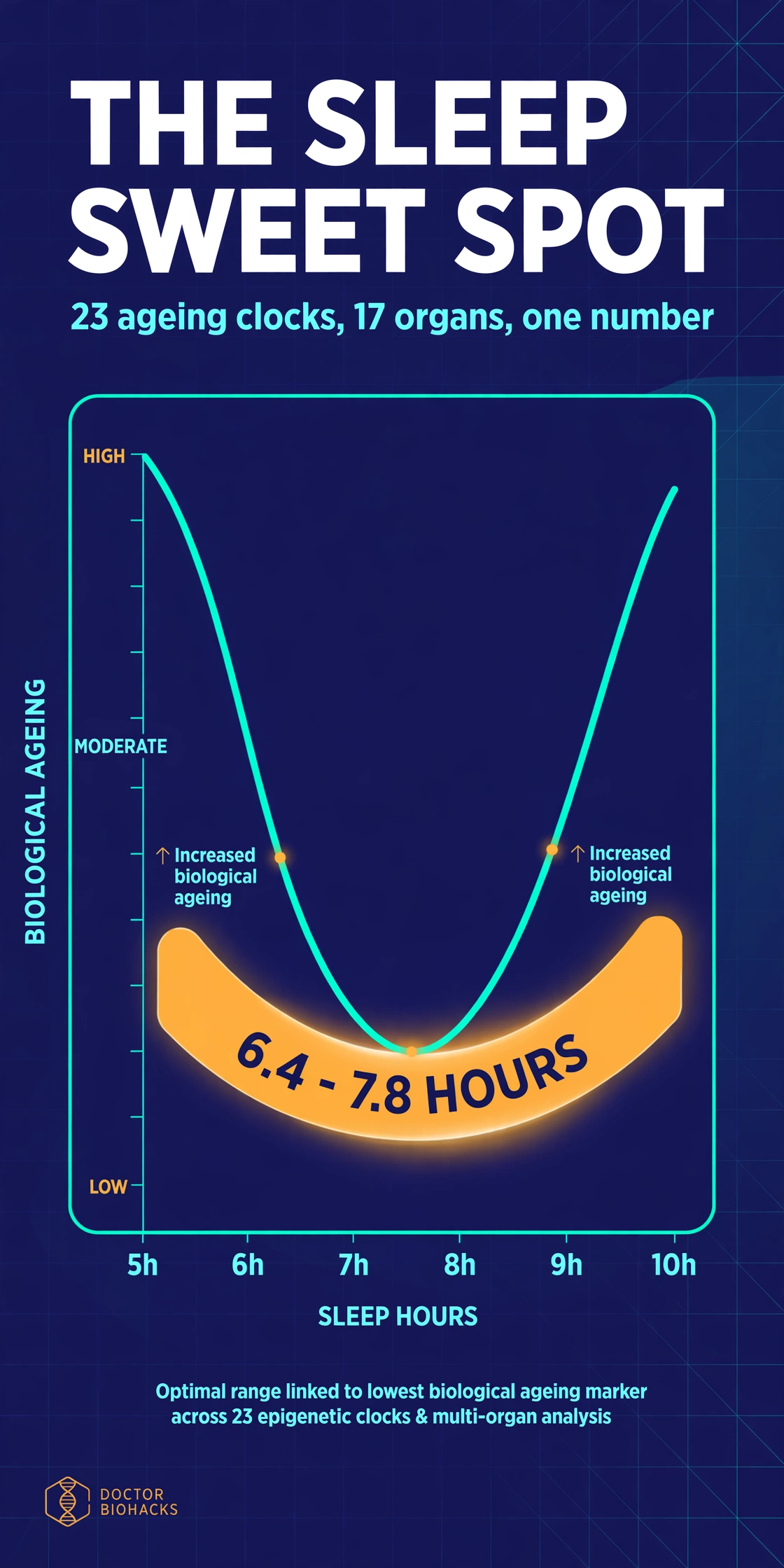
If you track your sleep, you have probably asked yourself the optimiser’s question: what is the actual number? Not the NHS range of seven to nine hours, but the specific duration, for your body, that ages you slowest. A 2026 Columbia University study has put the tightest evidence-based answer yet on the table: across 23 biological ageing clocks and 17 organ systems, the slowest measured ageing sat between 6.4 and 7.8 hours of sleep per night.
That is narrower than the familiar eight-hour advice, and it matters because most sleep trackers already collect exactly the data you need to position yourself against it. Here is what the research actually found, what it cannot prove, and a four-week protocol for dialling in your own sweet spot without guessing.
The short answer
What is the optimal sleep duration for longevity? The strongest recent evidence points to roughly 6.4 to 7.8 hours of actual sleep per night. That is the window linked to the lowest biological age across the body in a study of half a million UK Biobank participants. Sleep under six hours or over eight hours was associated with faster biological ageing. Treat the window as a starting target, then refine it against your own tracker data, your daytime energy and your sleep quality.
Why the Columbia study changed the conversation
Most sleep research has asked whether sleep affects the brain. The Columbia team, led by Junhao Wen, assistant professor of radiology at Columbia University Vagelos College of Physicians and Surgeons, took a whole-body approach. Using data from half a million participants in the UK Biobank (aged 37 to 84), they built 23 separate biological ageing clocks covering 17 organ systems. Instead of collapsing the body into one number, they made organ-specific clocks from structural medical imaging, organ-specific proteins and molecules found in blood, allowing them to check whether sleep’s relationship with ageing held across different biological layers rather than being an artefact of one measurement method.
Then they mapped each participant’s self-reported sleep duration against all 23 clocks. The result was a coordinated U-shaped pattern across the entire body: both short sleep (under six hours) and long sleep (over eight hours) were associated with faster ageing, while the lowest biological age gaps clustered between 6.4 and 7.8 hours. The curve showed up in the heart, lungs, immune system and digestive tract, not just the brain.
The authors were careful about what this does and does not prove. As the Columbia release noted, the finding does not mean sleep duration alone causes organs to age faster or slower; both insufficient and excessive sleep may be markers of poorer overall health. Short sleep was also significantly associated with depressive episodes, anxiety disorders, type 2 diabetes, heart disease and obesity in the same dataset.
Wen’s own summary of the takeaway: the study shows that too little and too much sleep are associated with faster ageing in nearly every organ, supporting the idea that sleep matters for maintaining organ health within a coordinated brain-body network.
What about the NHS seven-to-nine-hour guidance?
There is no contradiction here, just a difference in resolution. NHS-linked guidance (Professor Simon Kyle of Oxford, writing for the NIHR’s Be Part of Research) says adults should aim for between seven and nine hours, while explicitly adding that it is very individual: for some people six hours might be appropriate, whereas others might need nine, and timing, regularity and continuity all matter alongside duration.
The Columbia window of 6.4 to 7.8 hours sits mostly inside the lower half of that official range. It does not tell you to aim for less sleep than you need. It tells you that chasing nine hours when your body does well on seven is not the longevity move you might think it is.
How much sleep is too much? The long-sleep side of the U
The short-sleep arm of the curve gets the headlines, but the long-sleep arm is the one most biohackers ignore. Sleeping consistently over eight or nine hours is a well-documented marker of underlying health problems rather than a damaging behaviour in itself: it tracks with depression, undiagnosed sleep apnoea, hypothyroidism, chronic inflammation and neurodegenerative disease.
That distinction matters for self-experimentation. If your tracker says you are sleeping nine hours a night and your daytime energy is poor, the right response is not to force yourself awake at hour seven. It is to look at fragmentation (how often you wake), sleep apnoea risk and your overall health, possibly with a clinician. Duration targets only work when sleep quality is already decent.
The second lever: consistency beats duration alone
Duration is only half the chronobiology story. A separate 2026 study, led by researchers at the Johns Hopkins Bloomberg School of Public Health and published in JAMA Network Open, found that how regularly you move between rest and activity is linked to how fast your body is ageing.
The details matter because they are modest and specific. Lead author Chunyu Liu, with co-senior authors Adam Spira and Brion Maher, analysed seven days of wrist-worn activity data from 207 adults in the long-running Baltimore Epidemiologic Catchment Area cohort (average age around 68), alongside blood tests measuring biological age on four epigenetic clocks. Participants with stronger, less fragmented and more day-to-day consistent rest-activity rhythms showed more youthful physiological age scores on two of the four clocks, even after accounting for chronological age, sex, education and health conditions.
This was an observational study in older adults with a small sample, so it does not prove that regularising your bedtime slows your ageing. But it gives the consistency protocol something concrete: the signal survived adjustment for the usual confounders, and the direction matches decades of circadian research. For a self-experimenter, it is the cheapest intervention available: a stable schedule costs nothing.
The four-week protocol: find your personal window
Here is how to turn these findings into a personal experiment using data you probably already collect.
Week 1: Establish your baseline. Export the last 28 nights from your tracker (Oura, WHOOP, Apple Watch, whatever you use). Record two numbers per night: total sleep time (not time in bed) and wake time consistency. Compute your median total sleep, your median bedtime and the range of your wake times. Most trackers report “time in bed” more generously than “sleep”; use sleep time for comparison with the 6.4 to 7.8 hour window.
Week 2: Position yourself. Where does your median sit relative to the window? If you are under 6 hours and your daytime energy lags, your job is sleep opportunity: earlier bedtime, not later alarm. If you are in the window and feel good, you are likely already at your sweet spot. If you are over 8 hours with poor energy, treat it as a quality investigation, not a target to defend.
Week 3: Fix consistency first. Pick one wake time and hold it within a 30-minute band, seven days a week, including weekends. Morning light within an hour of waking reinforces the signal. Social jet lag (weekend drift of two or more hours) is the most common consistency killer in tracker data, and it is fully under your control.
Week 4: Nudge one variable. If consistency is fixed and you are still off your target, change one thing: shift bedtime 20 minutes earlier or later, hold everything else, and watch a week of data. Change sleep opportunity, not just time in bed staring at the ceiling. Then reassess subjective energy with a simple 1 to 10 evening rating logged alongside the tracker data.
Five rules for interpreting your tracker honestly
- Compare sleep, not time in bed. The Columbia numbers describe self-reported sleep duration. Trackers over-report sleep relative to polysomnography; your tracker’s 7.2 hours may be someone’s self-reported 7.5. Direction matters more than the decimal.
- Judge against energy, not the graph. If your tracker says 6.5 hours and you feel sharp all day, do not chase 7.5. The window is a population statistic, not a personal prescription.
- Fix quality before chasing duration. High fragmentation, alcohol within three hours of bed, and late caffeine distort any duration target. Alcohol in particular suppresses REM sleep, the stage most associated with overnight recovery.
- Naps count in the daily total. The Columbia data used daily sleep hours, not night-time alone. If you nap regularly, fold naps into your total before concluding you are short.
- Re-baseline quarterly. Travel, training blocks, stress and seasons all shift the number. Your sweet spot is a range you maintain, not a number you hit once.
What the evidence still cannot tell you
Three honest limits. First, the Columbia study is observational and uses self-reported sleep, so it establishes association, not causation. Second, both long sleep and short sleep can be markers of conditions that themselves accelerate ageing, so the arrow may run partly the other way. Third, individual sleep need genuinely varies: genetics, age, activity level and health all shift the right number for you, which is exactly why the protocol above measures rather than assumes.
What the two 2026 studies together give you is a well-defined prior to test against your own data: a 6.4 to 7.8 hour window, a consistent schedule, and quality sleep as the foundation. That is more than most longevity advice manages.
Frequently asked questions
Is sleeping 9 hours bad for longevity? Not necessarily bad in itself. In the Columbia study, sleep over eight hours was associated with faster biological ageing, but long sleep is often a marker of underlying health issues (depression, sleep apnoea, chronic inflammation) rather than the cause. If you sleep nine hours and feel good, that may simply be your need. If you sleep nine hours and still feel tired, look at sleep quality and consider speaking with a clinician.
What is the best sleep duration for slowing biological ageing? The tightest evidence-based estimate comes from the 2026 Columbia University study of 23 biological ageing clocks: 6.4 to 7.8 hours of sleep per night was associated with the lowest biological age across 17 organ systems. NHS guidance of seven to nine hours overlaps this window, and individual need varies.
Does a regular bedtime actually slow ageing? No study has proved causation. The 2026 Johns Hopkins study (207 older adults) found that stronger, more consistent rest-activity rhythms were associated with more youthful epigenetic age scores. It is an observational finding in a small, older sample, but it aligns with decades of circadian research and is a free intervention worth testing on yourself.
Should I trust my wearable’s sleep number? Use it as a trend, not a truth. Wearables estimate sleep from movement and heart rate and can differ from clinical sleep studies by meaningful margins. Track the same device over time, compare week to week rather than night to night, and pair the numbers with a subjective energy rating.
How long does it take to see whether a sleep change works? Give any single change at least one to two weeks before judging it. Sleep architecture and circadian rhythms adjust over days, not hours, and one bad night tells you nothing. Track for four weeks minimum before drawing conclusions about a protocol change.
Sources
- The MULTI Consortium et al., “Sleep chart of biological aging clocks in middle and late life”, *Nature* (2026). DOI: 10.1038/s41586-026-10524-5. Columbia University news release, 13 May 2026.
- Liu C. et al., “24-Hour Rest-Activity Rhythms and Epigenetic Age Acceleration in Older Adults”, *JAMA Network Open* (published online 7 May 2026), led from Johns Hopkins Bloomberg School of Public Health.
- Simon Kyle, University of Oxford, “How much sleep do we need?”, Be Part of Research (NIHR), on NHS-aligned guidance of seven to nine hours for adults.
This article is for information only and is not medical advice. If you have a sleep disorder or a health condition, speak with a clinician before changing your sleep habits.


5 thoughts on “The 6.4 to 7.8 Hour Sleep Window: Dialling In Your Longevity Sweet Spot”