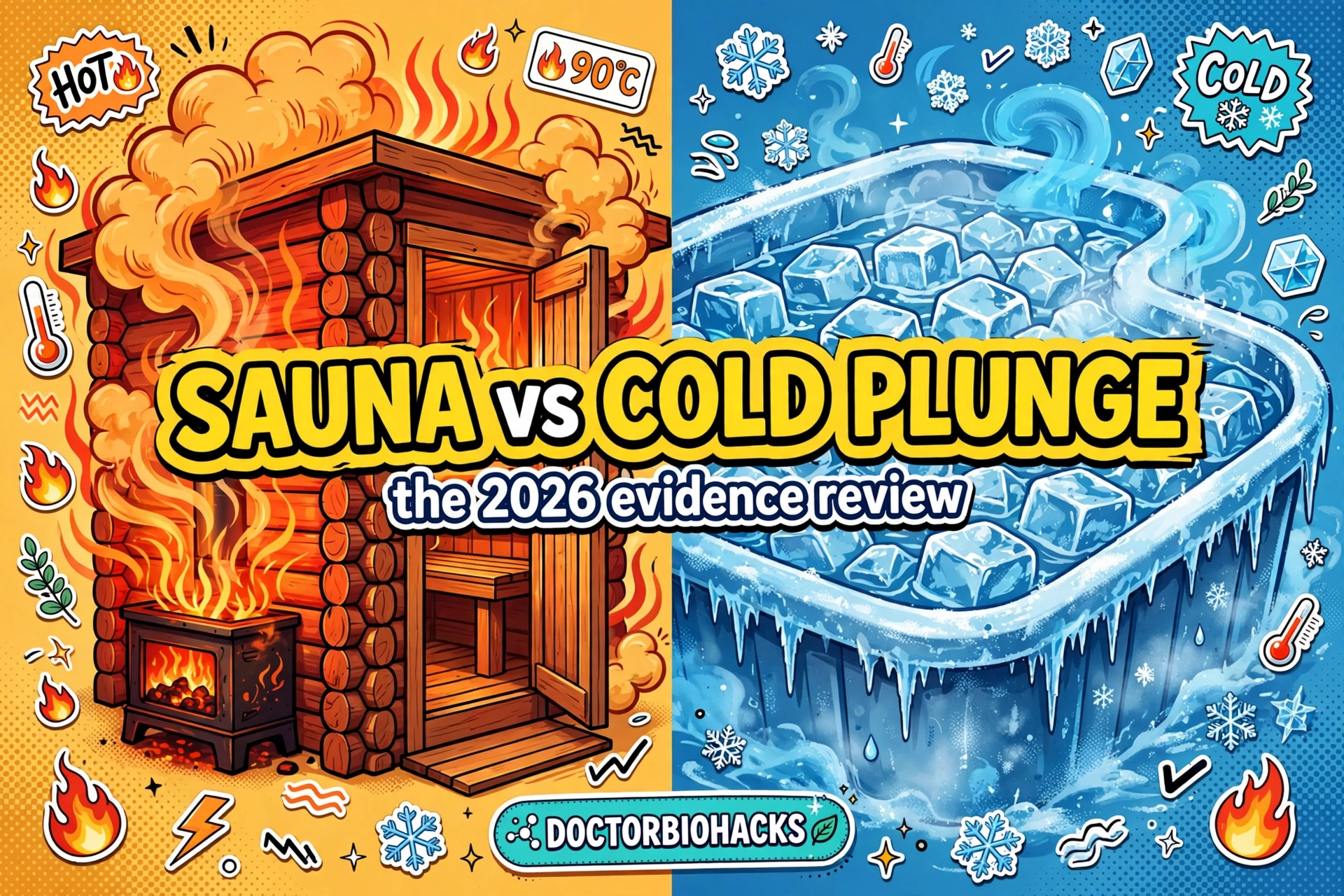
Sauna or Cold Plunge: Which Is Better for Recovery and Longevity?
Sauna or Cold Plunge: Which Is Better for Recovery and Longevity?
If you bought a chest freezer in 2023 just to sit in it, you were not alone. Cold plunging became the defining wellness ritual of the decade: ice baths in back gardens, plunge pools at boutique gyms, influencers filming their 6am shiver face. The promise was enormous. Less inflammation, faster recovery, sharper focus, maybe even a longer life.
Three years on, a quieter feeling has set in. Call it cold plunge fatigue. The daily ritual is expensive, time-consuming and, if we are honest, miserable. And a nagging question has started surfacing in comment sections and gym chats: is the ice bath actually earning its keep?
This article answers that question with the two strongest pieces of evidence available in 2026: a new umbrella review that synthesised 15 systematic reviews of cold water immersion, and two decades of Finnish sauna research tracking mortality. One side has perception. The other has outcomes. Here is what each one actually found, and the weekly protocol this self-experimenter is running as a result.
The quick answer: Cold water immersion reliably reduces perceived muscle soreness (a small to moderate effect lasting up to 72 hours), but shows no consistent benefit for strength or endurance performance, no consistent effect on systemic inflammation markers, and may blunt long-term strength adaptations. That is the verdict of a 2026 umbrella review of 15 systematic reviews covering 161 studies (Sports Medicine Open). Frequent sauna use, meanwhile, is linked to striking long-term outcomes: Finnish men using a sauna 4 to 7 times per week had 50% lower cardiovascular mortality and 40% lower all-cause mortality than once-weekly users over a median 20.7 years of follow-up (Laukkanen et al., JAMA Internal Medicine, 2015; observational, so association rather than proof). Verdict: cold plunges are a competition-day tool for feeling recovered fast. Saunas are the better-evidenced weekly investment for lifters and longevity seekers.
What the 2026 cold-water review actually found
The paper, published in Sports Medicine Open, is an umbrella review: a review of reviews. It synthesised 15 systematic reviews with meta-analysis, covering 161 original studies and 3,210 participants. Immersion protocols ran 3 to 20 minutes at 5 to 15°C, and the comparisons were passive recovery, active recovery, warm water immersion or contrast therapy.
Two caveats before the results. First, every one of the 15 reviews was rated low or critically low methodological quality, and most of the evidence was low to very low certainty. Second, the participants were predominantly young men, so generalising to everyone requires care. Even so, this is the most comprehensive synthesis we have, and its findings are remarkably consistent.
Strength recovery: no meaningful effect
Across four meta-analyses, cold water immersion did not significantly improve muscular strength recovery compared with passive or alternative recovery, at any point up to 168 hours. One analysis found a small significant benefit at 24 hours only. If you are dunking to get your squat back faster, the data says it is not working.
Endurance: a one-hour window
No consistent improvement in endurance performance. One meta-analysis found better endurance when tested within one hour of immersion, but the effect vanished at 6 and 24 hours. That is useful if you compete twice in one day and irrelevant for normal training weeks.
Muscle soreness: the one genuine win
Here cold water earns its reputation. Across the reviews, immersion significantly reduced perceived muscle soreness, both immediately (effect sizes of -0.59 to -1.10) and at 24 to 72 hours (effect sizes of -0.34 to -0.89). These are small to moderate effects, and soreness is subjective, but subjective matters: feeling recovered is often what decides whether you train.
Inflammation: no consistent effect
This is where the marketing collapses. The review found no consistent effect on systemic inflammatory markers such as CRP and IL-6 up to 72 hours, and effects on lactate were inconsistent and unlikely to matter given how fast lactate clears naturally. The “ice bath flushes inflammation out of your muscles” story is not supported by the pooled data.
The long-term cost: possibly blunted strength adaptations
The most uncomfortable finding for regular plungers. Malta and colleagues concluded that post-exercise cold water immersion has adverse effects on long-term muscular strength adaptations, and Grgic’s subgroup analysis found that immersing the exercised limb dampened longer-term strength adaptations. The proposed logic is straightforward: the same inflammatory signalling that makes you sore is part of how muscle adapts and grows. Blunt it every session and you may blunt the adaptation too. If hypertrophy is your goal, an ice bath after every lift could be taxing your gains.
What cold plunges cost you
Set the science aside for a moment and do the maths on the ritual itself. A decent plunge setup costs hundreds of pounds, needs ice or a chiller running constantly, takes up garden or bathroom space, and demands several minutes of genuine suffering per session, several times a week, indefinitely. What you buy with that investment, per the 2026 synthesis, is less perceived soreness and not much else. No proven strength or endurance benefit, no consistent anti-inflammatory effect, no long-term outcome data at all, and a possible tax on your strength gains. That is a steep price for feeling slightly less sore.
What the Finnish sauna data actually says
Now the heat side. The strongest long-term data on any thermal practice comes from the Kuopio Ischaemic Heart Disease Risk Factor Study (KIHD) in Finland, where sauna is a way of life rather than a wellness trend.
Laukkanen and colleagues followed 2,315 Finnish men for a median of 20.7 years, recording sauna habits at baseline and tracking cardiovascular events and deaths. The results were dose-dependent. Compared with men who used a sauna once a week, those who used one 4 to 7 times per week had 63% lower risk of sudden cardiac death (hazard ratio 0.37), 48% lower risk of fatal coronary heart disease, 50% lower risk of fatal cardiovascular disease, and 40% lower all-cause mortality.
These associations held after adjusting for age, BMI, systolic blood pressure, LDL cholesterol, smoking, alcohol consumption, previous heart attack, type 2 diabetes, cardiorespiratory fitness, resting heart rate, physical activity and socioeconomic status. Session duration mattered too: sessions longer than 19 minutes were linked to 52% lower sudden cardiac death risk than sessions under 11 minutes. The cohort’s saunas averaged around 79°C with typical sessions of about 20 minutes.
The pattern held for women. A 2018 extension in 1,688 women (BMC Medicine) found 4 to 7 weekly sessions linked to 70% lower cardiovascular mortality than once weekly. And a 2018 systematic review in Mayo Clinic Proceedings concluded sauna bathing may be linked to reduced risk of vascular diseases including high blood pressure, cardiovascular disease and neurocognitive disease.
The honest caveats: this is observational data. Sauna habits were self-reported, the cohort is Finnish, and frequent sauna users may differ from infrequent ones in ways no adjustment fully captures. There are no randomised trials with mortality endpoints, and there likely never will be. Association is not proof. But it is a strong, dose-dependent association, replicated across sexes, with plausible candidate mechanisms under investigation: heat shock protein induction, improved arterial compliance, autonomic nervous system regulation and effects on inflammation biomarkers.
When a cold plunge still wins
Fairness requires the carve-out. The umbrella review’s own discussion positions cold water immersion as genuinely useful in specific scenarios: tournament play, matches across consecutive days, and high-intensity endurance sessions in the heat. In those contexts it lowers thermal and cardiovascular strain, speeds perceptual and autonomic recovery, and can restore endurance performance within hours. If you compete on Saturday and again on Sunday, the ice bath is a legitimate tool. It is a competition-day instrument, not a longevity strategy.
The weekly heat protocol (self-experimenter edition)
Here is the protocol the evidence points to, translated into something a busy person can actually run.
The target: 4 sauna sessions per week. That is the frequency band with the strongest outcome data (the 4 to 7 group), and four is the achievable end of it.
Temperature and duration: aim for a traditional sauna around 79°C and stay in for at least 19 minutes. The duration finding is one of the most actionable in the whole literature: the over-19-minute group did meaningfully better than the under-11-minute group.
Build up gradually: if you are new to heat, start at 2 sessions per week for 10 to 15 minutes and add one session every one to two weeks. Heat tolerance adapts like any other stressor.
What to track: this is a biohacking site, so measure it. Log resting heart rate and morning HRV, sleep quality, and a simple 1 to 10 perceived recovery score. Give the protocol 8 to 12 weeks, then look at the trends, not single days.
Safety basics: hydrate before and after, skip alcohol before a session, cool down gradually rather than shocking the system, and if you have a cardiovascular condition, check with your clinician before starting a frequent heat protocol. Never sauna alone when trying new extremes.
The cold plunge, demoted but not deleted: keep it for the scenarios where the evidence supports it (back-to-back competition days, brutal heat). Move it away from your lifting days if hypertrophy is the goal.
Frequently asked questions
Is sauna or cold plunge better for muscle recovery?
For perceived soreness, the cold plunge wins: the 2026 umbrella review found small to moderate soreness reductions lasting up to 72 hours. For everything else that matters to a self-experimenter (strength recovery, inflammation markers, long-term outcomes), the sauna has the stronger evidence base and no adaptation-blunting signal.
Does cold water immersion reduce inflammation?
Not consistently. The 2026 umbrella review of 15 systematic reviews found no consistent effect on systemic inflammatory markers such as CRP and IL-6 up to 72 hours post-exercise.
How many sauna sessions per week are linked to longevity benefits?
Four to seven sessions per week versus once weekly is the band with the strongest observational data: 50% lower cardiovascular mortality and 40% lower all-cause mortality in Finnish men over roughly 20 years, with a similar pattern in women.
Does cold plunge blunt muscle growth?
The evidence points that way for regular use. Malta and colleagues concluded post-exercise cold water immersion has adverse effects on long-term muscular strength adaptations. If hypertrophy is your priority, avoid ice baths immediately after lifting sessions.
Can sauna replace exercise?
No. The Finnish sauna users were also physically active, and the mortality analyses adjusted for cardiorespiratory fitness and activity. Treat sauna as an adjunct to training, not a substitute.
How hot should the sauna be, and for how long?
The KIHD cohort averaged around 79°C, and sessions longer than 19 minutes showed the strongest associations with lower sudden cardiac death risk. Build up to that gradually.
The bottom line
Cold plunge fatigue is rational. The 2026 evidence says the ice bath is a good analgesic and a poor investment: it makes you feel less sore while doing little for performance, nothing consistent for inflammation, and possibly taxing your long-term strength gains. The sauna, unglamorous and ancient, carries the best long-term outcome data of any recovery practice studied, with a clear dose (4 sessions a week, 19+ minutes, properly hot) that a self-experimenter can actually run. Heat won this round. Keep the freezer for tournament weekends.
Sources
- Umbrella review of 15 systematic reviews of post-exercise cold-water immersion, Sports Medicine Open, 2026 (DOI: 10.1186/s40798-026-01116-8)
- Laukkanen T et al., Association between sauna bathing and fatal cardiovascular and all-cause mortality events, JAMA Internal Medicine, 2015 (KIHD cohort, 2,315 men, median 20.7 years follow-up)
- Laukkanen T et al., Sauna bathing is associated with reduced cardiovascular mortality and improves risk prediction in men and women, BMC Medicine, 2018 (1,688 women)
- Laukkanen JA et al., Cardiovascular and other health benefits of sauna bathing: a review of the evidence, Mayo Clinic Proceedings, 2018