Does Grip Strength Predict Longevity? Two Strength Tests and How to Hit the Top Quartile
Does Grip Strength Predict Longevity? The Short Answer
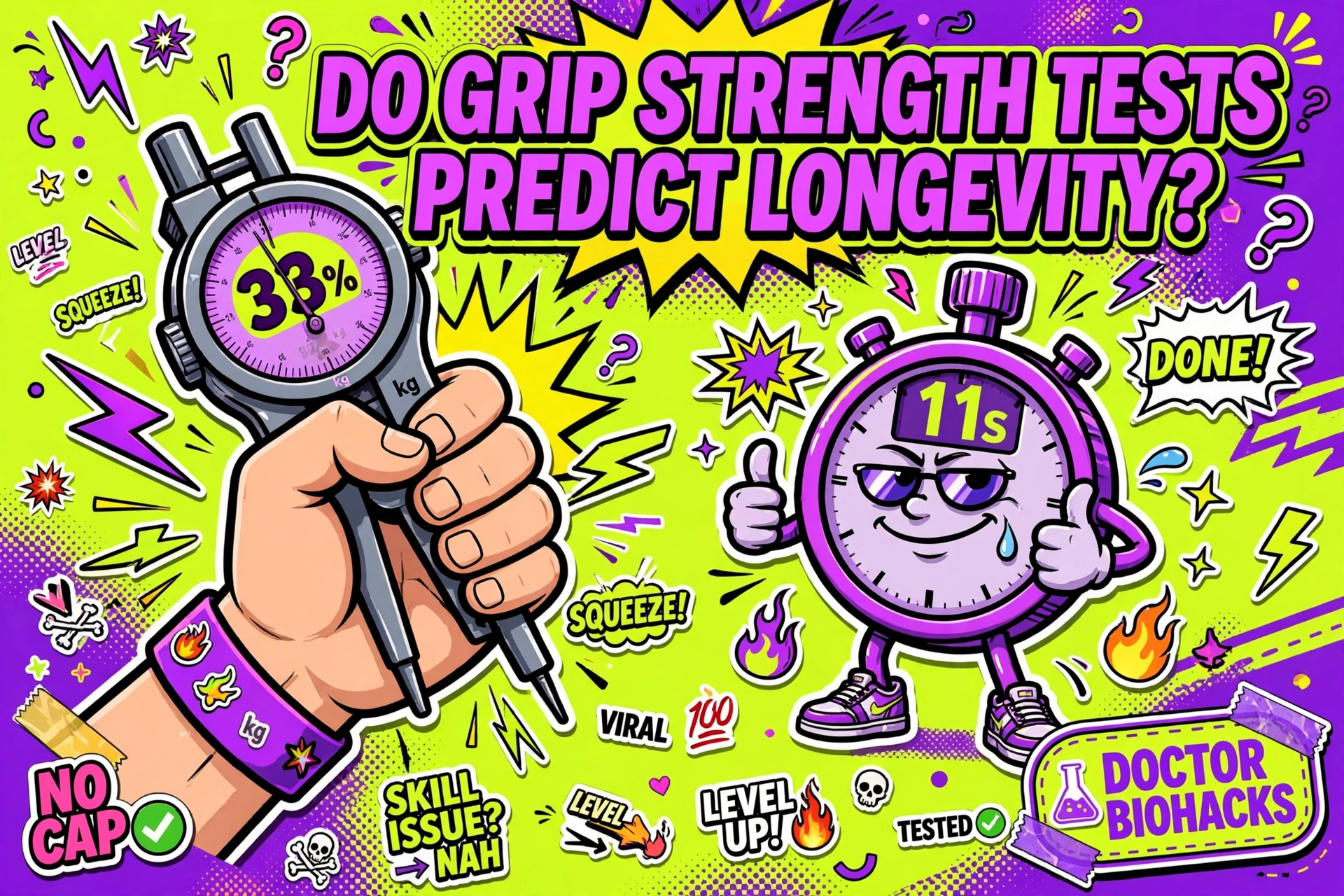
Yes. In a JAMA Network Open study published in February 2026, researchers followed 5,472 women aged 63 to 99 for a mean of 8.4 years. Women in the top quarter for grip strength had 33% lower all-cause mortality than women in the bottom quarter. Women with the fastest chair-stand times had 37% lower mortality. Crucially, the link survived adjustment for how much the women exercised, how much they sat, their walking speed and a blood marker of inflammation. Strength carried its own protective weight, separate from cardio fitness.
That makes two cheap tests, a hand squeeze and five chair stands, among the simplest longevity screens you can run at home. This article gives you the exact targets from the study and a practical protocol for climbing into the top quartile.
What the Study Actually Measured
The study was led by Michael J. LaMonte, research professor of epidemiology and environmental health at the University at Buffalo, and published online on 13 February 2026 in JAMA Network Open. The cohort: 5,472 women, aged 63 to 99, all able to walk independently. Strength was measured two ways at baseline:
- Grip strength, using a hand dynamometer, the same device your GP might use.
- Chair stand time: five consecutive sit-to-stand raises from a standard chair, arms crossed over the chest, timed in seconds.
Participants also wore hip accelerometers for seven days, so activity and sedentary time were measured objectively rather than self-reported, which is unusual and important for a study like this.
Here are the headline results, with hazard ratios for all-cause mortality across quartiles:
- Grip strength quartiles: under 14 kg, 14 to 19 kg, 20 to 24 kg, over 24 kg. Compared with the weakest quarter, mortality was 33% lower in the strongest quarter (hazard ratio 0.67, 95% confidence interval 0.58 to 0.78). Every extra 7 kg of grip strength was linked to 12% lower mortality.
- Chair stand quartiles: 16.7 seconds or slower, 16.6 to 13.7 s, 13.6 to 11.2 s, 11.1 s or faster. Compared with the slowest quarter, mortality was 37% lower in the fastest quarter (hazard ratio 0.63, 95% confidence interval 0.54 to 0.73). Each 6-second improvement in the test was linked to 4% lower mortality.
What makes this study harder to dismiss than earlier work: the associations held after adjusting for age, body weight, smoking, comorbidities, blood pressure, alcohol, sedentary time, moderate-to-vigorous activity, walking speed (a proxy for cardiovascular fitness) and C-reactive protein, a blood marker of inflammation. They also held across subgroups defined by age, body mass index and activity level. Even among women who did not meet the standard 150 minutes per week of moderate aerobic activity, stronger grip still predicted lower mortality.
What Counts as “Top Quartile”: The Exact Targets
The targets below are the quartile cut-offs from the study itself. They describe women aged 63 to 99, so treat them as benchmarks, not as clinical thresholds for your own age group.
- Grip strength, top quartile: over 24 kg per hand (dynamometer, best of two or three attempts).
- Grip strength, bottom quartile: under 14 kg.
- Chair stand, top quartile: five stands in 11.1 seconds or faster.
- Chair stand, bottom quartile: 16.7 seconds or slower.
For wider context, the European Working Group on Sarcopenia in Older People (EWGSOP2) defines low grip strength as under 27 kg for men and under 16 kg for women. And the association is not women-only: a UK Biobank analysis of 502,293 adults aged 40 to 69, published in the BMJ in 2018, found that each 5 kg lower grip strength was associated with a 20% higher all-cause mortality hazard in women and a 16% higher hazard in men. The tests work the same for both sexes; the top-quartile numbers are the study-specific benchmarks.
How to Run Both Tests at Home Today
Replicate the study protocol as closely as you can.
The grip test. A hand dynamometer is inexpensive and widely available online and in gyms. Sit upright, elbow bent at 90 degrees, wrist straight. Squeeze as hard as you can for three seconds. Rest one minute, repeat on the other hand, then do a second round. Record your best reading per hand. Warm up first with a few light squeezes, because a cold grip reads artificially low.
The chair stand test. Use a standard dining-height chair pushed against a wall so it cannot slide. Sit with your back flat against the backrest and your arms crossed over your chest. On your signal, stand fully upright, then sit back down, five times, as fast as you can, without using your arms or pushing off your thighs. Time from the word go until you are fully standing after the fifth repetition. Have someone else time you, because self-timing adds error.
Safety first: if you have knee, hip or back problems, skip the timed version and ask your GP or a physiotherapist about alternatives. One sloppy maximal test is not worth an injury.
Why Would Grip Strength Track Survival?
The honest answer first: nobody has proven causation. This is an observational study. Strength predicted survival after heavy adjustment, but adjustment cannot remove every confounder, and no randomised trial has shown that raising your grip strength extends your life. What the study does show is that strength is not merely a proxy for being active. The researchers measured activity objectively, and the signal survived.
The likely explanation is that grip strength captures something broader than hand muscles. In the study, chair stand time behaved more like a broad ageing indicator, while grip tracked raw muscle output. Muscle is metabolically active tissue, it supports movement against gravity, and as LaMonte put it: “When we no longer can get out of the chair and move around, we are in trouble.” That is why clinicians already use these tests in geriatric settings; they condense frailty, function and reserve into two numbers.
LaMonte’s practical summary is worth quoting: “Healthy aging probably is best pursued through adequate amounts of both aerobic and muscle-strengthening physical activities.” This is not an either-or with cardio. It is an addition.
The Protocol: How to Climb Into the Top Quartile
No trial shows that training these specific numbers extends life. But the direction of travel is unambiguous, and general strength training is the only evidence-based way to move the numbers. Here is the simple, repeatable protocol.
Train the pattern, not just the muscle. Grip responds to carrying and hanging. Add farmer’s carries (walk with heavy dumbbells or kettlebells, 3 sets of 40 metres, twice a week), dead hangs from a pull-up bar (build to 60 seconds across sets) and slow eccentric wrist curls. Legs respond to squatting through full range. Box squats and goblet squats, 3 sets of 8 to 12, twice a week, are the chair-stand training equivalent.
Progress gradually. Add a little load or a few seconds each week. Tendons adapt more slowly than muscles, which is why grip work especially rewards patience. If your hands are already sore from typing all day, start with one grip session a week.
Keep protein adequate. Time-restricted eating maintained weight loss at 12 months in a recent trial, but the same trial found persistent fat-free mass loss across all fasting groups. If you fast, pairing it with resistance training and adequate protein is the muscle-preserving move, and it directly supports the numbers in this protocol.
Recover like it matters. Strength adaptations happen between sessions. Light movement, sleep and heat-based recovery all help. If you are choosing where to put recovery time, sauna has the stronger evidence base for recovery investment than cold plunging.
Re-test monthly, same conditions. Same dynamometer, same chair, same time of day, roughly the same warm-up. Log the best-of-two per hand and your five-stand time. Trends matter more than single readings: you are looking for the grip number rising by a kilogram or two per month and the chair time falling by fractions of a second.
Track objectively. The LaMonte study’s strength came from measured, not self-reported, data. Self-experimenters should do the same: log the numbers in a spreadsheet or an app, and if you already track metrics with a wearable, add these two tests to the same review session each month so they sit alongside your sleep and recovery data.
The One Caveat You Should Not Skip
A strong grip is a marker, not a prescription. People who are stronger may differ from weaker people in ways no statistical model can fully capture. The study cohort was women aged 63 to 99, so the exact cut-offs do not map neatly onto a 35-year-old man. The tests predict, they do not prove. Treat a weak reading as a reason to train, not as a diagnosis, and treat a strong reading as one good signal among many.
Frequently Asked Questions
Does grip strength predict longevity?
In the 2026 JAMA Network Open study of 5,472 women aged 63 to 99, yes: top-quartile grip strength (over 24 kg) was linked to 33% lower all-cause mortality over about eight years, independently of physical activity, sedentary time and cardiovascular fitness markers. A UK Biobank analysis of over half a million adults found each 5 kg lower grip associated with 20% higher mortality hazard in women and 16% higher in men.
How fast should the chair stand test be?
In the LaMonte study, five unassisted chair stands in 11.1 seconds or faster put women in the fastest, longest-lived quartile, with 37% lower mortality than the slowest quarter. The slowest quartile took 16.7 seconds or longer. Use a standard-height chair against a wall, arms crossed, and have someone else time you.
Do these tests work for men too?
The LaMonte study enrolled women only, so its exact quartile cut-offs come from women. The association itself is not women-only: the UK Biobank cohort of 502,293 adults found the grip-strength mortality link in both sexes. The European EWGSOP2 criteria use under 27 kg (men) and under 16 kg (women) as the low-strength threshold.
Will training my grip help me live longer?
Unknown. The studies are observational, and no randomised trial has shown that raising grip strength extends life. But resistance training is the established way to build strength, and guidelines consistently pair it with aerobic activity for healthy ageing. Train strength because the association is strong, not because causation is proven.
How often should I retest?
Monthly is enough. Strength changes slowly, so retesting weekly adds noise. Keep conditions identical: same dynamometer, same chair, same time of day, same warm-up, best of two attempts per hand.
Is strength training more important than cardio?
No, it is complementary. In the LaMonte study, grip strength predicted mortality even in women below the 150-minute weekly aerobic guideline, which argues for doing both. LaMonte’s own summary: healthy ageing needs adequate amounts of aerobic and muscle-strengthening activity.
Sources
- LaMonte MJ et al. Muscular strength and mortality in women aged 63 to 99 years. JAMA Network Open, published online 13 February 2026. DOI: 10.1001/jamanetworkopen.2025.59367. Full text
- University at Buffalo news release on the LaMonte study, 13 February 2026: Study: For women over 60, muscle strength matters
- Celis-Morales CA et al. Associations of grip strength with cardiovascular, respiratory, and cancer outcomes and all cause mortality: prospective cohort study of half a million UK Biobank participants. BMJ 2018;361:k1651.
- EWGSOP2 sarcopenia criteria (Cruz-Jentoft et al., Age and Ageing 2019): low grip strength defined as under 27 kg for men and under 16 kg for women.