Can Habit Stacking Add Years to Your Life? What the 60,000-Person Study Found
Can habit stacking really add years to your life?
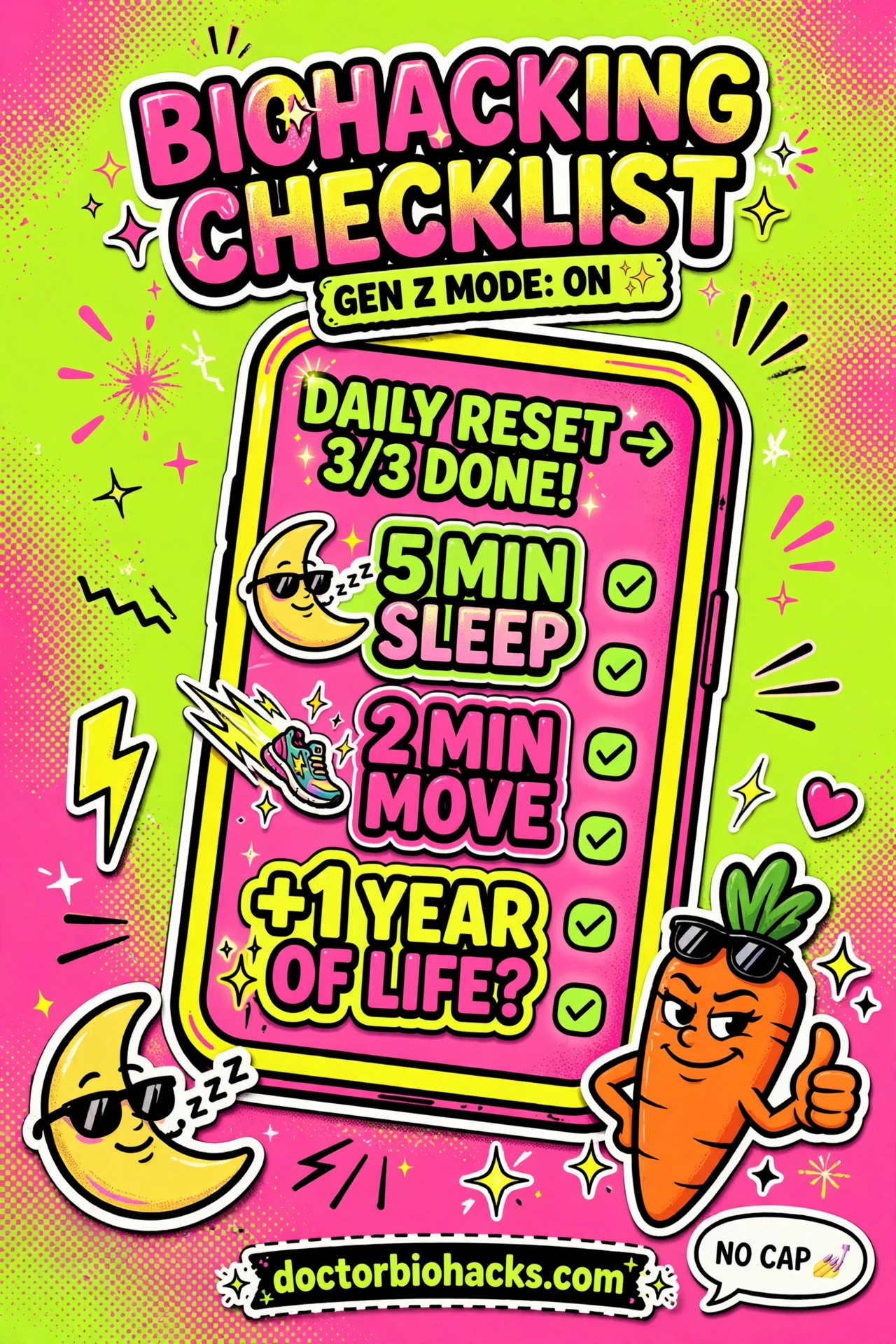
Here is the short answer. A University of Sydney study of nearly 60,000 UK Biobank adults found that people who combined small improvements in sleep, movement and diet were associated with up to 9.35 additional years of life and 9.45 additional years of healthspan, compared with people whose habits sat at the worst end of the scale. The most striking figure: adding just five minutes of sleep per day, 1.9 minutes of moderate-to-vigorous movement per day and a five-point improvement in diet quality was associated with one extra year of life. Habit stacking is the delivery mechanism that makes those tiny combined changes stick, by anchoring each new behaviour to a routine you already run on autopilot.
This article decodes the study for self-experimenters, then gives you a three-stack protocol to run the experiment on yourself, with metrics to track and honest limits on what the evidence can claim.
What is habit stacking?
Habit stacking is the practice of attaching a new behaviour to one you already do consistently, using the existing routine as an anchor. Instead of building a morning exercise routine from scratch, you link two minutes of brisk movement to something automatic, like waiting for the kettle to boil. The old habit becomes the trigger for the new one.
The term was popularised by James Clear in his bestselling book Atomic Habits, and it grew out of the behaviour-design research of scientist BJ Fogg, whose work showed that new behaviours stick best when they ride on the back of existing ones. Psychologist Craig Kain, who uses habit stacking in his clinical work, puts it bluntly: “Building habits has nothing to do with strength or willpower. It has everything to do with developing a method.” The neurological logic is simple. An established habit is a well-travelled pathway; bolting a new behaviour next to it lets the new one run on autopilot sooner.
Kain also warns against rushing. In his experience, health-related habits typically take two to five months to become firmly established, and he advises waiting until one new behaviour feels genuinely effortless before adding the next. That patience matters, because the longevity study below rewards consistency over intensity.
The 60,000-person study, decoded
The research is titled “Minimum combined sleep, physical activity, and nutrition variations associated with lifeSPAN and healthSPAN improvements: a population cohort study.” It was carried out by researchers at the University of Sydney and published in eClinicalMedicine, a Lancet journal, as an open-access article. The team followed nearly 60,000 UK Biobank adults for an average of eight years.
What makes this study unusually solid for a lifestyle paper is how the behaviours were measured. Sleep duration and moderate-to-vigorous physical activity (MVPA) were recorded with wrist accelerometers rather than self-report questionnaires, which removes a lot of wishful thinking. Diet quality was scored on a 0 to 100 Diet Quality Score covering vegetables, fruits, grains, meats, fish, dairy, oils and sugary drinks.
Three sets of findings matter for self-experimenters:
- The headline association. Compared with the theoretically worst combination of behaviours, the best combination, roughly 7.2 to 8 hours of sleep per day, more than 42 minutes per day of MVPA and a high diet quality score, was associated with 9.35 additional years of lifespan (95% CI: 6.67 to 11.63) and 9.45 additional years of healthspan, the years lived in good health.
- The minimum meaningful change. Compared with people at the lowest 5th percentile of the three behaviours combined, an additional five minutes of sleep per day, 1.9 minutes of MVPA per day and a five-point increase in diet quality were associated with one additional year of life. That diet shift is roughly equivalent to half a serving more vegetables per day or 1.5 servings more whole grains.
- The healthspan target. Four extra disease-free years were associated with a bigger but still modest combined shift: 24 extra minutes of sleep, 3.7 minutes of MVPA and a 23-point diet quality increase.
Two patterns stand out. First, the trend was near-linear: as the combined behaviours improved, the associated years gained kept rising, and packaging the three behaviours together beat any single one on its own. Second, movement was the single strongest driver. Once MVPA passed about 22 minutes per day, the benefits became clear regardless of the sleep and diet levels, which tells you where to put your first unit of effort.
Read the caveats before you rebuild your routine
An honest protocol read has to say what the study cannot prove. This is observational research, so it identifies associations rather than proving cause and effect. The accelerometer data is objective, but diet was still self-reported, and the life-expectancy figures are modelled, with wide confidence intervals. The cohort also skews older and healthier than the general population, since UK Biobank volunteers tend to be better off and more health-conscious than average, so the numbers may not map perfectly onto younger or less active groups.
The baseline point matters too. The biggest associated gains came from people starting with the poorest habits. If you already sleep seven and a half hours, train regularly and eat well, your marginal gains from five extra minutes of sleep will be far smaller. That is not a reason to ignore the findings; it is a reason to measure your own baseline first and focus on whichever of the three levers is currently your weakest.
The habit-stacking longevity protocol
The study’s minimum-change figures translate neatly into three stacks. Each one anchors a tiny new behaviour to something you already do every day. The tracking metric after each stack is what turns this from a feel-good routine into a self-experiment.
Stack 1: Sleep, five minutes more
Anchor: brushing your teeth at night, which you already do. New behaviour: plug your phone in across the room instead of on the nightstand the moment you brush your teeth, and get into bed five minutes earlier than usual. The cross-room charger removes the scrolling that quietly eats those five minutes.
Track: nightly sleep duration from your wearable. Aim for the 7.2 to 8 hour window the study associated with the best outcomes, but treat the five-minute daily gain as the win, not the absolute number.
Stack 2: Movement, two minutes harder
Anchor: your existing daily walk, dog loop or commute. New behaviour: pick up the pace to brisk for the first two minutes, enough that talking takes slight effort. No existing walk? Anchor to the kettle boiling each morning and do two minutes of stair climbs or jogging on the spot while it heats.
Track: daily MVPA minutes. The study’s inflection point was around 22 minutes per day, where benefits became clear regardless of sleep and diet. If your baseline is 15 minutes, two extra brisk minutes are a genuine 13% increase in daily MVPA.
Stack 3: Diet, half a serving better
Anchor: making your morning coffee or tea. New behaviour: while it brews, add half a serving of vegetables to your breakfast prep or eat one piece of fruit. The study’s five-point diet quality shift was equivalent to roughly half a serving of vegetables or 1.5 servings of whole grains per day.
Track: a simple daily tally of vegetable and whole-grain servings. You do not need a full diet diary; a single number in your notes app is enough to see whether the average is climbing.
A six-week starter plan
Week zero is baseline only: track sleep, MVPA minutes and vegetable servings for seven days without changing anything. Weeks one and two, run Stack 1 alone. Weeks three and four, add Stack 2 once the sleep change feels automatic. Weeks five and six, add Stack 3. This pacing follows Kain’s two-months-to-automaticity guidance: one behaviour at a time, no stacking a stack until the first runs itself.
At week six, compare your averages with baseline. The study suggests that if your combined behaviours have moved even slightly, you are on the curve that is associated with extra healthy years. The honest version of the claim is narrower: you will have measurably better sleep, more movement and a better diet than six weeks ago, and those are the inputs the cohort data links to longer healthspan.
Frequently asked questions
Can habit stacking add years to your life?
No study has tested habit stacking itself against lifespan. What the University of Sydney cohort study showed is that small combined improvements in sleep, movement and diet were associated with up to 9.35 extra years of lifespan. Habit stacking is simply the behaviour-change method for making those small improvements stick, by anchoring them to routines you already have.
Is two minutes of extra exercise really enough to matter?
In the study, an extra 1.9 minutes of MVPA per day, combined with five more minutes of sleep and a small diet improvement, was associated with one extra year of life versus the lowest baseline group. Movement was the single strongest contributor. Two minutes is the floor, not the ceiling; more movement kept adding associated gains up to well over 40 minutes per day.
How long does it take for a habit stack to stick?
Clinical experience cited in the coverage suggests health habits typically take two to five months to become firmly established, and it varies considerably between people. Run one stack at a time and add the next only when the first feels effortless.
Does combining habits beat improving just one?
In this cohort, yes. The study found that packaging sleep, physical activity and diet together produced greater associated gains than any single behaviour alone, with a near-linear trend across the combined scores. That is the statistical case for habit stacking rather than single-habit optimisation.
What counts as a high-quality diet in the study?
The Diet Quality Score ran from 0 to 100 across vegetables, fruits, grains, meats, fish, dairy, oils and sugary drinks. The most favourable group scored between 57.5 and 72.5. You do not need a perfect diet; moving the score a few points upward was part of the minimum change associated with an extra year of life.
Do these findings apply to younger, already-active people?
Probably less strongly. The cohort skewed toward older adults, and the largest associated gains came from people with the poorest baseline habits. If your habits are already strong, treat the protocol as maintenance plus measurement rather than expecting the headline nine-year figures.
Related reading: our guide to the 6.4 to 7.8 hour sleep-longevity window, the morning light therapy protocol for easier wake-ups, and how to track your metrics with the most accurate wearable.
Sources
- University of Sydney cohort study: “Minimum combined sleep, physical activity, and nutrition variations associated with lifeSPAN and healthSPAN improvements: a population cohort study,” eClinicalMedicine (The Lancet), open access: full text
- Marisa McMillan, “How to Use Habit Stacking for Longevity,” Outside Online, 8 Oct 2026: article
- CNN, “These small life changes could extend your life by at least a year, study says,” 14 Jan 2026: coverage