What 6 Habits Are Aging You Faster? (And What to Do Instead)
What 6 Habits Are Aging You Faster?
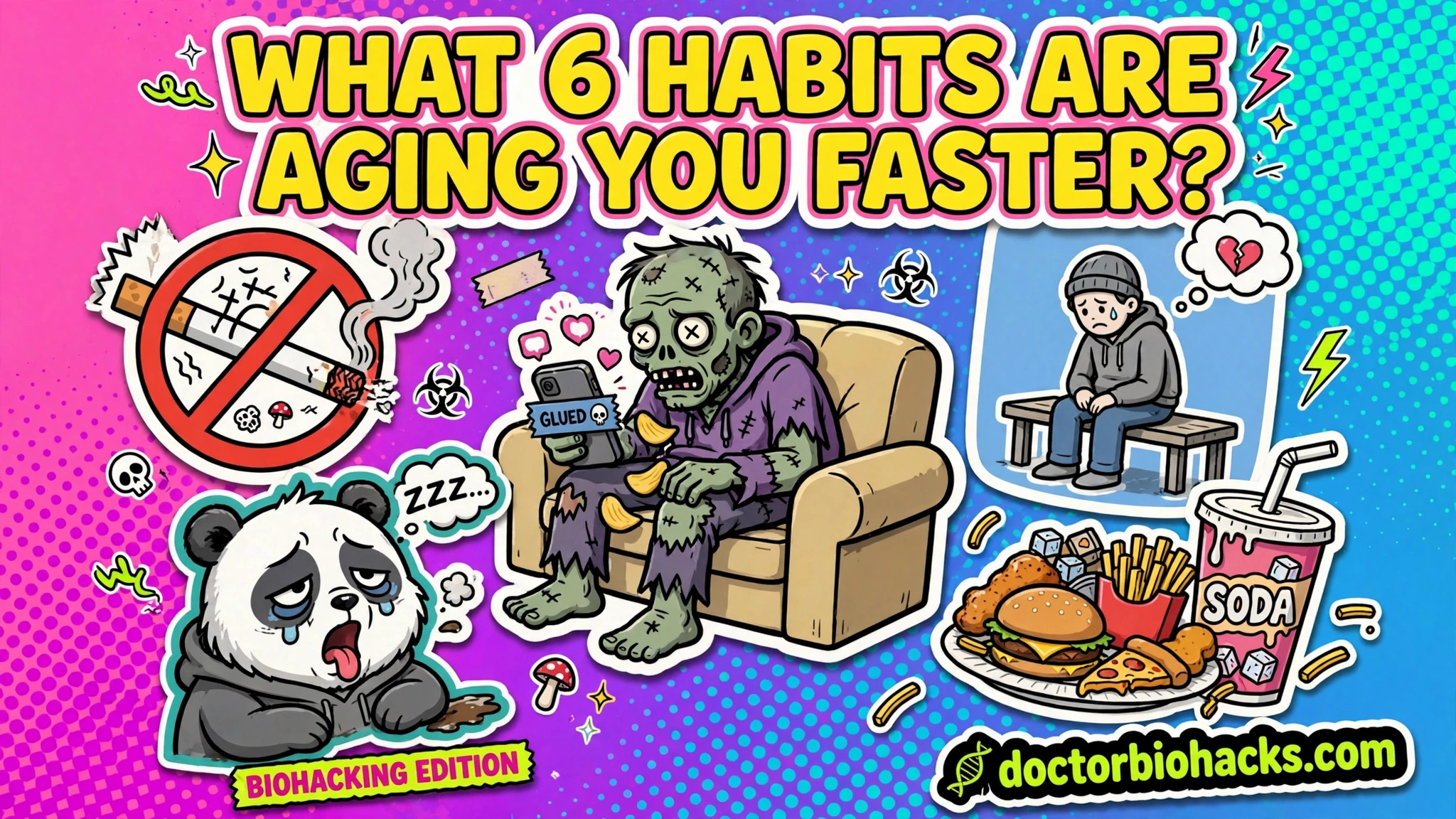
What 6 habits are aging you faster? Smoking, sitting all day, sleeping under 6 hours, drinking heavily, living on ultra-processed food and chronic loneliness. Researchers can now estimate how fast your body is aging by reading chemical marks on your DNA, known as epigenetic clocks, and all six of these habits are linked to an older biological age on the clocks most closely tied to disease and mortality. The encouraging part is that at least two of the studies found the damage can be at least partly undone when the habit changes.
This article is the flip side of our positive rankings. We have already covered what increases lifespan the most and whether small habit changes can add years to your life. Here we go through the six everyday habits with the strongest published evidence for accelerated biological ageing, with the exact figures from the papers and an honest fix for each one.
First, What Is Biological Age and How Is It Measured?
Your chronological age is just the number of birthdays. Your biological age is an estimate of how worn your cells actually are. The most studied way to estimate it is the epigenetic clock: mathematical models that read methylation patterns (chemical tags on DNA) at specific sites in the genome and convert them into an age estimate. When the estimate runs ahead of your calendar age, researchers call the difference epigenetic age acceleration.
The field has moved through generations of clocks. First-generation clocks such as HorvathAge and HannumAge were trained to predict chronological age. Second-generation clocks such as PhenoAge and GrimAge were trained on clinical outcomes and predict mortality and disease. Third-generation clocks such as DunedinPACE estimate the pace of ageing itself: how fast your organ systems are deteriorating relative to your peers. The studies below use these clocks, and several find effects of a year or more on biological age. An important caveat that runs through all of them: most are observational, so they show associations, not proof of causation. Biological age estimates are also estimates, not diagnoses.
1. Does Smoking Accelerate Biological Ageing?
Yes, and a large new study quantifies how much is reversible. Published in October 2026 in the journal GeroScience, the analysis by Yeonju Kim and Habyeong Kang of Hanyang University used nationally representative data from 1,911 adults aged 50 to 84 in the US National Health and Nutrition Examination Survey (NHANES). Rather than relying on one clock, the team ran six validated DNA methylation clocks across three generations, from HorvathAge and HannumAge through PhenoAge and GrimAge2 to DunedinPoAm.
Across all six clocks, current smokers showed the highest epigenetic age acceleration of any group. The more important finding concerned former smokers: the longer a person had been quit, the lower their epigenetic age acceleration, in a clear dose-response pattern. Former smokers who had been smoke-free for 20 years or more had GrimAge2 acceleration 12.66 years lower than current smokers (95% confidence interval 10.75 to 14.56 years). That is close to the profile of never smokers, whose GrimAge2 acceleration was 13.88 years lower than current smokers (CI 12.05 to 15.70). Statistical modelling suggested the steepest decline happened during the first decade after quitting, with continued gradual improvement beyond 20 years.
The honest limitation: the study is cross-sectional, so it compared different people at different quit durations rather than following the same individuals over time. Even so, it is some of the clearest population-level evidence that smoking’s molecular fingerprint on ageing is not necessarily permanent.
What to do instead: Quit, and keep counting. The data suggest the biggest epigenetic recovery happens in the first ten smoke-free years, but benefits keep accruing for decades. For the millions of former smokers wondering whether the harm is already done, the molecular answer appears to be that much of it can be undone.
2. Is Sitting All Day Really Ageing Your Cells?
Sedentary time shows up on ageing clocks too. A Japanese study using the Saga J-MICC cohort looked at 867 adults aged 40 to 69 and measured both movement and sitting with accelerometers rather than questionnaires. In the published Clinical Epigenetics analysis, objectively measured physical activity was associated with decelerated PhenoAge and GrimAge, while sedentary time was associated with accelerated epigenetic ageing. Notably, self-reported activity showed no such association, which suggests the honest signal comes from what people actually do, not what they say they do.
A separate, older study from UC San Diego took a different biomarker: telomeres, the protective caps on chromosome ends that shorten as cells age. Among nearly 1,500 women aged 64 to 95 in the Women’s Health Initiative, those who sat for more than 10 hours a day with less than 40 minutes of moderate-to-vigorous physical activity had cells that were biologically about 8 years older than the least sedentary women (published in the American Journal of Epidemiology).
A study published only days before this article added an interaction worth knowing: the detrimental association between sitting time and GrimAge was attenuated, and even reversed, with higher levels of physical activity, especially in people with good sleep quality. In other words, the ratio of movement to stillness may matter as much as either behaviour alone.
What to do instead: Break sitting into shorter blocks. Stand, walk or do a few squats every half hour. Aim for the standard guidance of at least 150 minutes of moderate activity per week. The newest evidence suggests active people can partly offset long sitting days, and good sleep amplifies the protection.
3. Does Sleeping Less Than 6 Hours Age You Faster?
Short sleep is one of the most consistent accelerators in the literature. A study in Psychosomatic Medicine drew on 3,795 men and women aged 56 to 100 from the Health and Retirement Study, measuring epigenetic age from blood samples. People who reported under 6 hours of bedtime were classed as short sleepers. Short sleep was associated with an accelerated GrimAge of 1.29 years (95% CI 0.52 to 2.07 years), and insomnia alone with 0.49 years (CI 0.03 to 0.94). People with the combination of short sleep and insomnia had a GrimAge 0.97 years ahead of healthy sleepers and a measurably faster pace of ageing on DunedinPACE. The analyses adjusted for age, sex, race and ethnicity, education and obesity status.
The Young Finns study added a working-age perspective: longer sleep duration was associated with a slower DunedinPACE in adults. And a review in Innovation in Aging reported something optimistic from intervention studies: experimentally restricting sleep in older adults triggered gene expression changes linked to DNA damage and cellular senescence, but treating insomnia lowered senescence transcripts and slowed the pace of ageing measured by DunedinPACE. In other words, the clock responds in both directions.
What to do instead: Protect 7 to 8 hours and keep the schedule regular. Our own deep dive on the longevity sleep window covers how to find your personal sweet spot. If you suspect insomnia or sleep apnoea, get it treated; the evidence suggests the ageing clock notices.
4. How Much Alcohol Accelerates Ageing?
Here the evidence is dose dependent. A 2023 study in the journal Aging analysed 3,823 participants in the Framingham Heart Study, aged 24 to 92, looking at long-term average alcohol consumption against GrimAge and PhenoAge acceleration. In middle-aged participants (45 to 64), each additional standard drink of alcohol per day (about 14 grams of ethanol) was associated with a 0.71-year increase in PhenoAge acceleration; in older participants it was 0.60 years. The association was not significant in young participants aged 24 to 44. Notably, liquor was associated with greater age acceleration per drink than beer or wine, and up to 28% of the link between alcohol consumption and hypertension appeared to be mediated through epigenetic ageing.
At the heavy end, a study of 331 people with alcohol use disorder versus 201 healthy controls found a 2.22-year epigenetic age acceleration after adjusting for sex and blood cell composition, which stayed significant at 1.38 years after further adjustment for race, body mass index and smoking status. More severe drinking patterns were linked to greater acceleration.
The honest reading: light, occasional drinking does not show a clear clock signal in these studies, but each extra daily drink above that is associated with measurably older biological age, and the effect concentrates in middle age and beyond.
What to do instead: Cut back, and treat alcohol as a dose-response curve rather than a threshold. Spirits look worse per drink than beer or wine in the Framingham data, so if you drink, smaller quantities and lower-strength choices are the evidence-backed moves.
5. Is Ultra-Processed Food Ageing You From the Inside?
A Monash University study published in the journal Age and Ageing, led by nutritional biochemist Dr Barbara Cardoso, analysed 16,055 US adults aged 20 to 79 from NHANES 2003 to 2010, estimating biological age with the PhenoAge clock. It found a significant association between ultra-processed food consumption and accelerated biological ageing: for every 10% increase in the share of energy coming from ultra-processed foods, the gap between biological and chronological age widened by approximately 2.4 months. Participants in the highest consumption quintile (68 to 100% of energy from ultra-processed foods) were biologically 0.86 years older than those in the lowest quintile (39% or less). The association stayed significant after adjusting for diet quality and total energy intake, which suggests the effect goes beyond just calories or nutrients.
A separate line of work from the IRCCS Neuromed group, published in the American Journal of Clinical Nutrition, reached a compatible conclusion: high ultra-processed food consumption appeared to accelerate biological ageing in ways that go beyond the poor nutritional quality of these foods, possibly through the effects of industrial processing on the food matrix, gut bacteria and glucose metabolism.
What to do instead: Shift the share of your plate toward unprocessed and minimally processed foods. The Monash researchers’ own worked example is memorable: on a 2,000-calorie diet, an extra 200 calories of ultra-processed food (roughly an 80-gram serving of chicken bites or a small chocolate bar) was linked to the biological ageing process advancing by more than two months. Small swaps compound.
6. Does Loneliness Age You Faster Than Smoking?
This is the claim that gets the most attention, and it needs the most care. A 2022 study in Aging-US by Galkin and colleagues at Deep Longevity trained a deep-learning ageing clock on blood data from 11,914 Chinese adults. They found that psychological factors, such as feeling unhappy or being lonely, added up to 1.65 years to biological age, and that the aggregate effect of these factors exceeded the effects of biological sex, living area, marital status and smoking status. Press coverage summarised this as loneliness accelerating ageing more than smoking, which is what the model showed for that cohort, but it is one clock on one population.
Other studies point in the same direction with smaller effects. Freilich and colleagues analysed 4,018 US adults from the Health and Retirement Study and found that greater loneliness was weakly but consistently associated with greater epigenetic age acceleration across the Horvath, DunedinPACE and GrimAge clocks, and that loneliness predicted increases in chronic health conditions over time. A USC study of 169 pairs of twins identified 25 regions of DNA where methylation increased with loneliness, many near genes involved in immune response and inflammation. The US Surgeon General’s advisory has separately flagged chronically elevated stress hormones in isolated individuals as damaging to blood vessels and immune function.
The honest bottom line: loneliness shows up on ageing clocks across multiple cohorts and methods, but the “worse than smoking” headline comes from a single model and should not be quoted as universal fact.
What to do instead: Treat social connection as a longevity intervention. Regular contact with friends and family, community involvement and steady relationships are the behaviours the research keeps associating with slower clocks.
The Takeaway
Six habits with published links to accelerated biological ageing: smoking, long sedentary days, short sleep, heavy drinking, a diet dominated by ultra-processed food and chronic loneliness. Two honest caveats. First, almost all of this evidence is observational: the studies adjust for confounders, but they cannot prove these habits cause the clock to speed up. Second, epigenetic clocks are estimates, not diagnoses, and different clocks sometimes disagree.
But the direction of travel is consistent, and the encouraging signals are real: quitting smoking appears to unwind epigenetic damage over the years, and treating insomnia appears to slow the pace of ageing.
Frequently Asked Questions
What is an epigenetic clock?
An epigenetic clock is a mathematical model that reads chemical tags (methylation) on your DNA at specific sites and converts the pattern into an estimated biological age. First-generation clocks like HorvathAge predict chronological age; second-generation clocks like GrimAge and PhenoAge predict mortality and disease; third-generation clocks like DunedinPACE estimate the pace at which your body is ageing relative to your peers.
Can you reverse accelerated biological aging?
Partly, according to two lines of evidence. In a 2026 GeroScience study of 1,911 US adults, former smokers who had quit for 20 or more years had GrimAge2 acceleration 12.66 years lower than current smokers, close to the profile of never smokers. In intervention studies, treating insomnia lowered cellular senescence signals and slowed the pace of ageing measured by DunedinPACE. Both findings are associations rather than guarantees, and the smoking study was cross-sectional.
How much sleep is enough to avoid accelerated aging?
The studies point to a window rather than a single number. In the Health and Retirement Study, under 6 hours of bedtime was the threshold linked to 1.29 years of GrimAge acceleration. Research on the 6.4 to 7.8 hour window suggests that is where biological age runs lowest for most people. Regularity matters as much as duration.
Is a little alcohol really enough to speed up aging?
The Framingham analysis found no significant link in young adults and a dose-response pattern from middle age onward: each extra standard drink per day was associated with about 0.71 years of PhenoAge acceleration in the 45 to 64 group. Light, occasional drinking did not show a clear signal, but the evidence does not support a protective effect either. Spirits were associated with greater acceleration per drink than beer or wine.
Does loneliness really age you faster than smoking?
One 2022 Aging-US study of 11,914 Chinese adults found psychological factors added up to 1.65 years to biological age, with the aggregate effect exceeding that of smoking status. Other studies, including a 4,018-person US analysis, found smaller but consistent links between loneliness and epigenetic age acceleration. The headline comes from a single model and should not be treated as universal fact, but loneliness does show up on ageing clocks across multiple cohorts.
Which habit should you fix first?
Fix the one that applies to you most, but the largest single reversibility signal in the literature is smoking cessation, with the steepest epigenetic recovery in the first decade after quitting. After that, the evidence clusters around three moves with the broadest support: sleeping 7 to 8 hours regularly, breaking up sedentary days with real movement, and cutting ultra-processed food toward minimally processed alternatives.
Sources
- Kim Y, Kang H. Duration of smoking cessation and DNA methylation aging clocks among US adults: potential reversibility of smoking-induced biological aging. GeroScience. 2026. DOI: 10.1007/s11357-026-02535-x
- Influence of physical activity on the epigenetic clock: evidence from a Japanese cross-sectional study (Saga J-MICC, n=867). Clinical Epigenetics. 2024. full text
- Short sleep and insomnia are associated with accelerated epigenetic age (Health and Retirement Study, n=3,795). Psychosomatic Medicine. PMID: 37594243
- Wang M et al. Alcohol consumption and epigenetic age acceleration across human adulthood (Framingham Heart Study, n=3,823). Aging. 2023. DOI: 10.18632/aging.205153 (full text)
- Epigenetic aging is accelerated in alcohol use disorder and regulated by genetic variation in APOL2. PMC: PMC6901591
- Cardoso B et al. Ultra-processed food consumption and accelerated biological ageing (NHANES, n=16,055). Age and Ageing. Monash University summary: Monash Lens
- Galkin F et al. Psychological factors substantially contribute to biological aging: evidence from the aging rate in Chinese older adults. Aging-US. 2022. PMC: PMC9550255
- Freilich CD et al. Loneliness, epigenetic age acceleration, and chronic health conditions (Health and Retirement Study, n=4,018). Summary: PsyPost
Related reading on doctorbiohacks.com: What Increases Lifespan the Most? Ranked by the Evidence | Can Habit Stacking Add Years to Your Life? | What Are the Top 3 Supplements for Longevity?