What Are the Top 3 Supplements for Longevity? What Research Actually Supports
The short answer
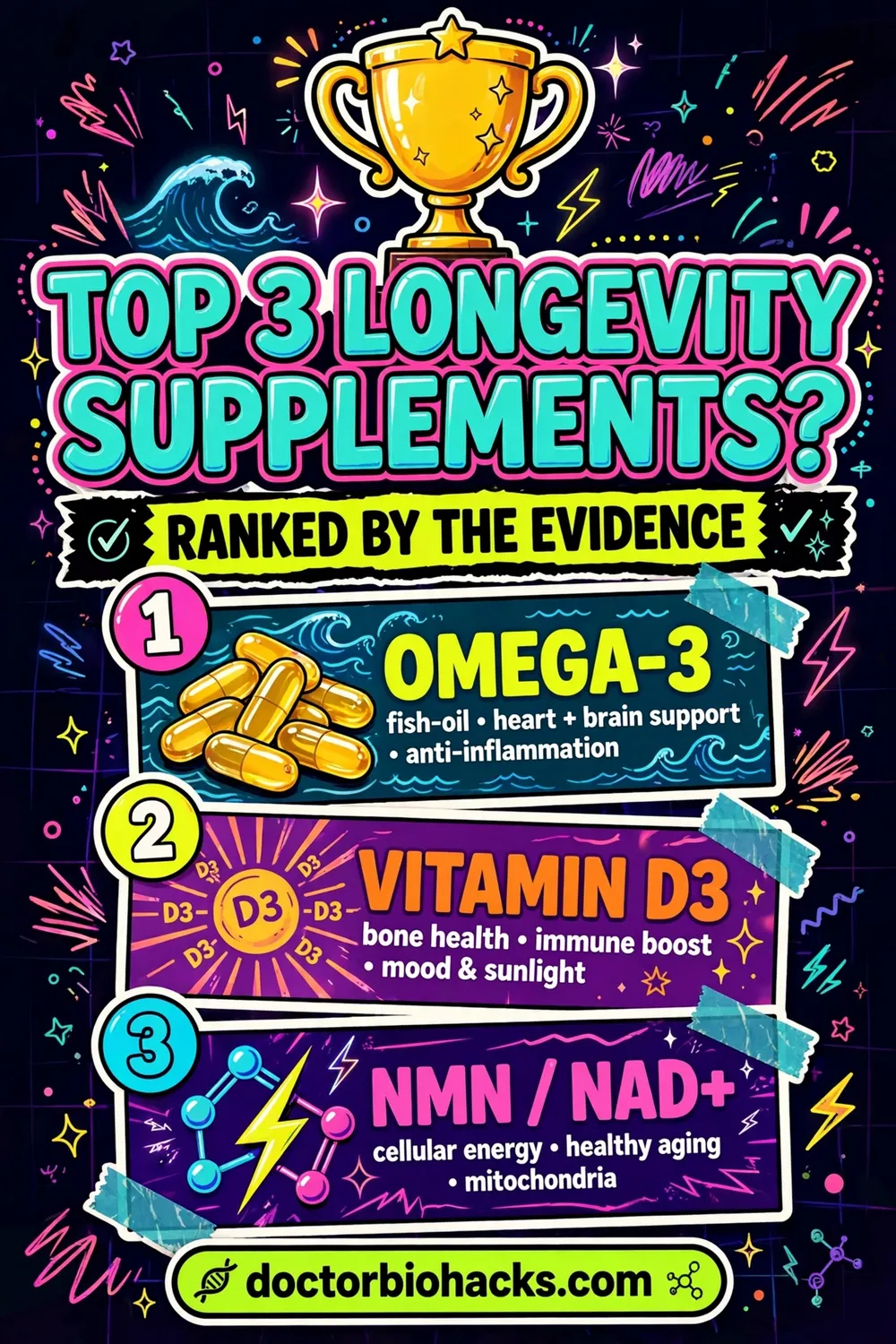
What are the top 3 supplements for longevity? Ranked strictly by human evidence on ageing-relevant outcomes, they are: omega-3 fatty acids (1 g a day, the only supplement with trial evidence of slowed biological ageing), vitamin D3 (2,000 IU a day, strongest as part of a three-part stack that cut invasive cancer by 61 percent), and NAD+ boosters such as NMN (250 mg a day, the most promising of the hyped options, with early but small human trials). One caveat sits above the whole ranking: no supplement has been shown to extend human lifespan in a randomised controlled trial. Everything below is ranked on biomarkers and disease outcomes, not on years of life, and the article says plainly where the evidence stops.
First, the honest rule behind this ranking
Longevity is full of confident supplement lists built on animal studies and wishful extrapolation. Mice that live longer on a molecule tell you almost nothing about what happens in a human body over decades, and the biohacking lane deserves better than that. So this ranking uses one rule: human randomised trial evidence on ageing-relevant outcomes, weighted by trial size, duration and how directly the outcome measures ageing. Observational associations do not qualify. Cell studies do not qualify. Longevity podcasts do not qualify. That rule is exactly why the list is only three deep and why the third place comes with a long caveat.
The yardstick that makes this ranking possible is the epigenetic clock: algorithms such as PhenoAge and GrimAge that read DNA methylation patterns and estimate biological age, which predicts mortality far better than birthdays do. For the first time, we have trial data showing a supplement moving those clocks. That is the foundation of everything below.
Number 1: Omega-3 fatty acids (1 g a day)
Omega-3 tops this list because it is the only supplement with randomised trial evidence of actually slowing biological ageing in humans. In February 2025, researchers published a post-hoc analysis of the DO-HEALTH trial in Nature Aging (Bischoff-Ferrari and colleagues), following 777 Swiss adults aged 70 or older over three years. Participants received either vitamin D (2,000 IU a day), omega-3 (1 g a day), a home exercise programme, or combinations.
Omega-3 alone slowed three of the four next-generation biological ageing clocks tested: PhenoAge, GrimAge2 and DunedinPACE. The standardised effects ranged from 0.16 to 0.32 units, which translates to roughly 2.9 to 3.8 months of slowed biological ageing over the three years, up to around four months at the top end. All three interventions together, omega-3 plus vitamin D plus exercise, showed an additive benefit on the PhenoAge clock.
Keep the size of the effect in perspective. A few months of clock-slowing over three years is modest, and the analysis was post hoc rather than the trial’s primary aim. But it is still a human signal on the most credible ageing measure we have, which is more than any other supplement on this list can show. Omega-3 also arrives with decades of cardiovascular and cognitive support behind it, so a longevity protocol built on it is not betting on a single fragile finding. If you track anything, track it sensibly: 1 g of marine omega-3 a day is the dose the trial used.
Number 2: Vitamin D3 (2,000 IU a day)
Vitamin D earns second place, but the honest version of this claim is narrower than most headlines admit. In the epigenetic-clock analysis of DO-HEALTH, vitamin D alone did not significantly slow any biological ageing clock. If you take D3 purely to move your epigenetic age, the trial data does not support you.
What it does support is the combination. In a separate DO-HEALTH analysis, published in Frontiers in Aging in April 2022, 2,157 generally healthy adults aged 70 or older were randomised into eight groups testing vitamin D3 (2,000 IU a day), omega-3 (1 g a day) and a simple home exercise programme (SHEP) alone and in combination over three years. Individually, each intervention had a small benefit on invasive cancer risk. Together, all three cut the risk of invasive cancer by 61 percent, the first randomised trial to show such a combination effect on cancer prevention in this age group. It was an exploratory analysis needing replication, but the signal is genuinely striking.
That is the real case for vitamin D in a longevity stack: it is not a solo star, it is a multiplier. Autumn and winter supplementation is already routine guidance in the UK (the NHS recommends considering a daily 10-microgram supplement from October to March), and the DO-HEALTH dose of 2,000 IU a day is well above that but was used safely for three years in the trial. Pair it with omega-3 and consistent exercise rather than expecting it to work alone. Deficiency is common enough that getting blood levels tested before committing to a year-round high dose is the sensible first step.
Number 3: NAD+ boosters, chiefly NMN (250 mg a day)
Third place is where honesty costs the most. Nicotinamide mononucleotide (NMN), an NAD+ precursor, is the most-hyped molecule in longevity right now, with genuine lifespan extensions in mice. In humans, the evidence is early, small, and mixed, which is exactly why it lands at number three with a warning label.
The strongest human trial is Yoshino and colleagues’ 2021 study in Science, at Washington University School of Medicine. Twenty-five postmenopausal women with prediabetes (13 on NMN, 12 on placebo) took 250 mg of NMN a day for 10 weeks. The NMN group improved skeletal muscle insulin sensitivity by about 25 percent, measured by the gold-standard hyperinsulinemic-euglycemic clamp, alongside improved insulin signalling in muscle. That is a real, measured metabolic effect, not a questionnaire.
The boundaries matter just as much. The same trial found no change in fasting glucose, blood pressure, blood lipid profile, liver fat or inflammatory markers. A 2026 meta-analysis of 15 NMN trials found no significant effect on body weight, BMI, fasting glucose or lipids. The positive signal is narrow: muscle insulin sensitivity in prediabetic women. There is no human lifespan data for NMN at all, and mouse metabolism is not human metabolism. If you experiment with NAD+ boosters, treat them as the highest-risk, least-proven part of your stack and budget accordingly.
How to self-experiment without fooling yourself
A supplement protocol is only as good as its measurement. Three rules keep the biohacking honest. First, change one variable at a time: stacking omega-3, vitamin D and NMN all at once tells you nothing about which one did anything. Second, track objective biomarkers, not feelings: fasting glucose, HbA1c, lipid profile, blood pressure, resting heart rate variability and C-reactive protein are cheap, repeatable and hard to placebo. A biological-age blood test every 12 months is the closest thing to a longevity endpoint available, but even that fluctuates, so treat single results with suspicion. Third, give each intervention a full three months before judging it, since epigenetic and metabolic markers move slowly.
Practically, a sane starting stack looks like this: 1 g of marine omega-3 a day with food, vitamin D3 at 2,000 IU a day (check your blood level first, and most UK adults can drop back to the NHS 10-microgram guidance through summer if levels are fine), and a consistent exercise programme before adding any NAD+ booster. The exercise part is not optional decoration: it was one of the three ingredients in the DO-HEALTH combination that cut cancer risk by 61 percent, and it was the additive element in the slowed biological ageing. Talk to your doctor before starting, especially if you take anticoagulants (omega-3 interacts) or any medication metabolised through pathways supplements can nudge.
The popular picks that did not make the list
Resveratrol is the grandfather of longevity hype, but human trials have been consistently underwhelming at practical doses, and it does not clear the human-evidence bar for a top-three slot. Multivitamins have never shown meaningful longevity effects in trials. Rapamycin and metformin have serious longevity researchers interested, rapamycin extends lifespan across multiple species and metformin’s TAME trial is still pending, but both are prescription drugs with real side-effect profiles, not supplements, and neither has human lifespan data yet. The most honest sentence in longevity right now is that no molecule you can buy extends human lifespan in a trial. Everything on this page is damage reduction and biomarker improvement, which is still worth doing, but it is not immortality in a bottle.
Frequently asked questions
What are the top 3 supplements for longevity?
Ranked by human trial evidence on ageing-relevant outcomes: omega-3 fatty acids (1 g a day, slowed epigenetic ageing clocks in the DO-HEALTH trial), vitamin D3 (2,000 IU a day, strongest in a combination that cut invasive cancer by 61 percent), and NAD+ boosters such as NMN (250 mg a day, small positive human trials on muscle metabolism, no lifespan data). No supplement has been shown to extend human lifespan in a randomised trial.
Is there a supplement proven to extend human lifespan?
No. No supplement, food or drug has been shown to extend human lifespan in a randomised controlled trial. The best available human evidence for supplements covers biological-ageing biomarkers (epigenetic clocks) and disease outcomes such as invasive cancer risk. Anything claiming lifespan extension in humans is extrapolating from animal or observational data.
How much omega-3 should I take for longevity?
The DO-HEALTH trial used 1 g of marine omega-3 a day and found slowed biological ageing over three years. That is the dose with the strongest longevity-specific evidence. Take it with food to aid absorption, and talk to your doctor first if you use anticoagulant medication.
Does vitamin D slow ageing on its own?
Not according to the trial data: in the DO-HEALTH epigenetic analysis, vitamin D alone did not significantly slow biological-ageing clocks. Its longevity case is as a multiplier, in combination with omega-3 and exercise, where the trio cut invasive cancer risk by 61 percent. Correcting deficiency is still worthwhile, but expect combination effects rather than solo miracles.
Is NMN worth taking for longevity?
The evidence is early. One small trial found a 25 percent improvement in muscle insulin sensitivity in prediabetic women, but a pooled analysis of 15 trials found no effect on weight, glucose or lipids, and there is no human lifespan data. Treat NMN as the experimental end of a supplement stack, not its foundation.
Which supplement has the most human evidence for healthy ageing?
Omega-3 fatty acids, by a clear margin: they are the only supplement with randomised trial evidence of slowed biological ageing measured by epigenetic clocks, plus decades of cardiovascular research. Everything else on the longevity supplement shelf sits at least one evidence tier below.
Sources
- Bischoff-Ferrari HA et al., “Individual and additive effects of vitamin D, omega-3 and exercise on DNA methylation clocks of biological aging in older adults from the DO-HEALTH trial”, Nature Aging, 5, 376-385 (3 February 2025). nature.com/articles/s43587-024-00793-y
- Bischoff-Ferrari HA et al., “Combined Vitamin D, Omega-3 Fatty Acids, and a Simple Home Exercising Program May Decrease Cancer Risk Among Active Adults Aged 70 and Older: A Randomized Clinical Trial”, Frontiers in Aging, 25 April 2022. frontiersin.org
- Yoshino M et al., “Nicotinamide mononucleotide increases muscle insulin sensitivity in prediabetic women”, Science, 372(6547), 1224-1229 (22 April 2021). medicalxpress.com summary
- Frontiers in Pharmacology review of NMN human clinical trials (2024), summarising the Yoshino, Irie, Yi, Liao and other trial designs and outcomes. frontiersin.org
Related reading