

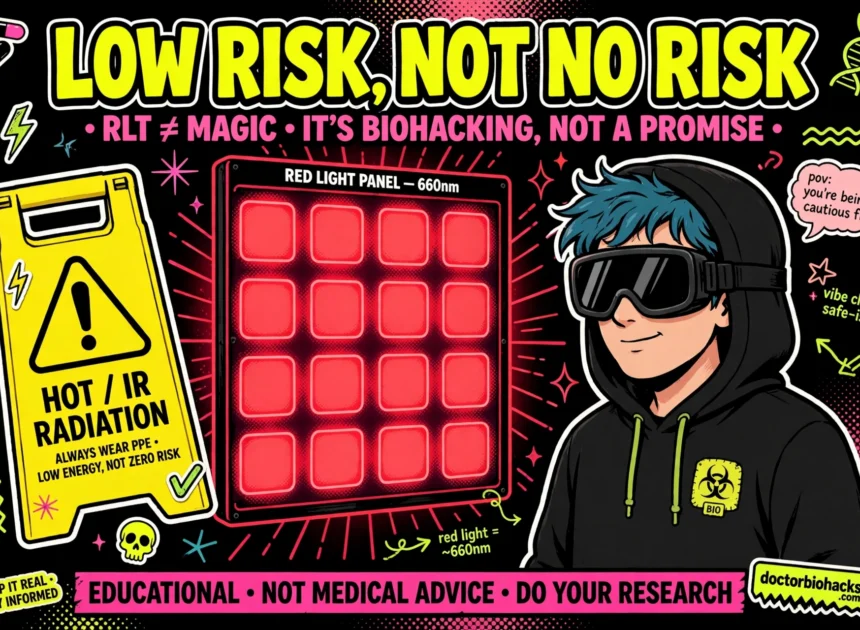


What is the downside of red light therapy? For most healthy adults who use a…

This is research news, not health advice. No study of one village can tell you how to change your own health. There is a new Sardinian longevity village on the map, and the researchers who found it did not go looking for a better diet plan. A team led by the University of Sassari’s Dr. […]
What does the new sex chromosomes longevity research actually mean for biohackers? The short answer: your X and Y chromosomes are not just a birth-assignment system. They run active programs inside your cells that shape how fast you age, how your immune system fights cancer, and how your heart handles decades of wear. A landmark […]
Lifting Weights for Longevity: What New Research Found (and How Much You Need) Lifting weights for longevity has one of the clearest dose targets of any health habit: about 90 to 120 minutes of strength training per week. That is the sweet spot found in a 30-year Harvard study of 147,000 adults, published in June […]
Quick answer: At ARDD 2026, the world’s leading longevity research meeting held October 1-3 at Harvard, regulators, Big Pharma and scientists agreed on a new standard: longevity therapies must prove measurable benefits in humans, not just longer mouse lives. The ARDD 2026 longevity pivot means intrinsic capacity scores, functional endpoints like VO2 max and aging […]
Six biological aging clocks measuring the body in completely different ways have converged on one molecule. In a new 52-week randomized trial, the AI-designed lung fibrosis drug rentosertib slowed biological aging by roughly 8 months to 4.5 years depending on which biological aging clock you read, in patients with idiopathic pulmonary fibrosis. The convergence is […]
Eat more protein to stay strong. Eat less protein to live longer. Both claims come from real research, and both cannot be fully right at the same time. Welcome to the protein paradox longevity puzzle: the molecular pathway the longevity world wants you to suppress is the same pathway that builds and protects your muscle. […]
A sweeping 2026 review of more than 350 studies found that eating less protein extended lifespan in laboratory animals by up to 50 percent. The researchers, led by Professor Dudley Lamming at the University of Wisconsin-Madison, argue that most sedentary adults eat more protein than they need, and the excess may accelerate aging. There is […]
The short answer on gene editing for cholesterol Yes, it is real. A single intravenous infusion of an experimental medicine called VERVE-102 used a precise form of CRISPR called base editing to switch off the PCSK9 gene in the liver. In the Phase 1 Heart-2 trial, LDL cholesterol fell by up to 62% in a […]
The short version The three free health habits are: get morning sunlight and dim evening screens to lock your circadian rhythm, eat protein and vegetables before carbs, and take the stairs instead of the lift. Finnish biohacker Teemu Arina, co-author of The Biohacker’s Handbook, named exactly these three when Monaco Life asked him what anyone […]
You cannot fully repay a week’s sleep debt with a weekend lie-in. In a controlled trial, adults who slept five hours on weeknights and as long as they liked at the weekend still showed the same metabolic disruption as people who skipped the catch-up entirely, and their reaction-time scores stayed well below fully rested controls […]